“The idea of work/life balance is a myth. There is teetering from one end and running to the other and hoping not to fall off.” – Sonya Walger.
Hello, students/working professionals. I am Aisha Khan, or what my friends call me, a “Dual-status learner.”
I just got my result of the EMBA qualification (yesterday). I CLEARED IT WITH FLYING COLORS. While I celebrate this milestone, I cannot help but reflect on the long journey it took to get me here.
One day, I was standing in the parking lot in front of my office at 9:00 AM on a rainy Tuesday. I looked at a 40-page corporate financial strategy framework which was due for my EMBA by midnight. I was working 50 hours a week as a Senior Product Manager. Honestly, I had expected that this was going to be an ordeal, yet I was not ready to spend my weekends on macroeconomics and leadership labs along with my team projects. It felt like trying to change the tyres of the car while driving it down the highway.
An EMBA is a catalyst for professional growth. It offers immediate dividends that you can apply to your day job in real time. But the sheer volume of work can quickly lead to chronic exhaustion, irritation, and mood swings that you cannot imagine.
But guess what?
While it seemed nearly impossible, I DID IT. I cannot be more proud of myself!
But how? That’s something you might be wondering (if you are in the same boat, managing different responsibilities).
This guide will show the framework I used to survive and thrive during my journey. So keep reading!
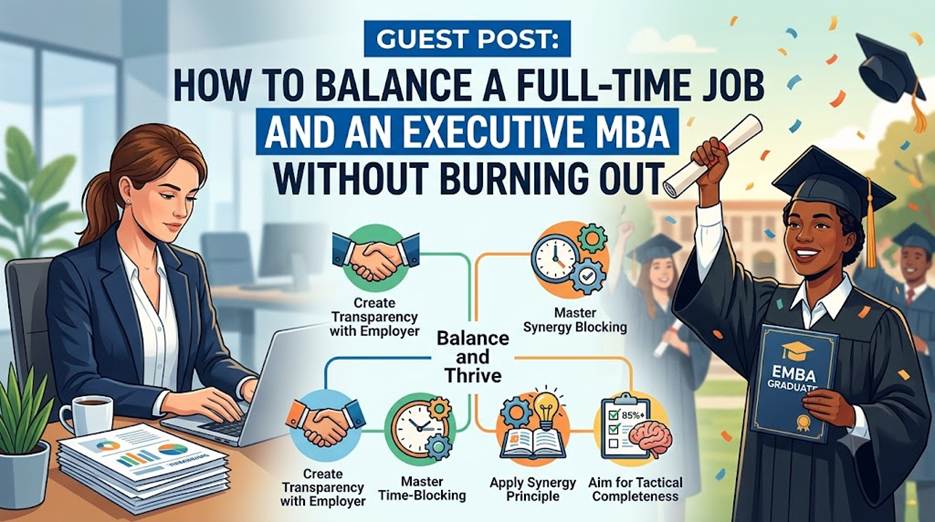
1. Create Transparency with Your Employer
The first mistake every EMBA candidate makes is believing to be a workplace superhero who acts as if nothing has changed. Your professional and personal circles need to know about your educational commitment from day one.
- Secure Executive Buy-In: Have a conversation with your manager before your classes start. Tell them that EMBA is not a distraction, but an R&D investment for the company. Also, state that you will be offline for residency modules or intensive workloads.
- Align with Your Study Team: Your EMBA class would be full of busy professionals just like you. So communicate with them and share your working hours along with working norms for group projects.
- Negotiate at Home: The major burden often falls on spouses and families. Communicate with them to offload some domestic tasks to save your time and energy. During this time, you can have a distraction-free study session.
2. Treat Time Management as a Hard Engineering Problem
Balancing a demanding job with a difficult academic program like EMBA is not easy. And individuals often lose track of their time (that is the biggest enemy). You need to shift from passive scheduling to proactive time planning.
I used a time-blocking methodology that treated hours like finite currency. I planned fixed hours, which were 5:30 to 7:30 every weekday for reading and working on my assignments. I promised myself to follow this routine to maintain work-life balance.
On weekends, like Saturdays, I designated that day for deep work. I kept all the time-consuming tasks or those that demand more focus.
3. Apply the Synergy Principle
The beauty of EMBA is that your workplace functions as a living laboratory for your coursework. So there is no need to treat work and studies separately. Instead, look for every opportunity to let them feed into each other using the synergy principle.
When you are assigned a corporate strategy or operations project in school, you can use challenges from your employer as the case study.
While I was working on my thesis, I chose a topic where I could easily apply my workplace’s experiences and information. I only had to seek MBA thesis writing help to structure the document. And voila, I completed it before the deadline was near.
4. Master the Art of “Tactical Completeness”
Perfection is often rewarded in undergraduate, full-time educational courses like an MBA. In EMBA, perfectionism often leads to mental and emotional frustration. You need to shift your mindset from flawless execution to executing with tactical completeness.
Understand that achieving an 85% efficiently is better than a 98% score that costs you sleepless nights and compromises your health.