Paid guest posting sits at the uncomfortable intersection of marketing, publishing, and SEO. Done well, it looks like a sponsored editorial collaboration: a brand funds a high-quality article that genuinely fits a publisher’s audience, and the publisher maintains full editorial control. Done poorly, it looks like buying links at scale, with thin content, aggressive anchor text, and “guaranteed dofollow” promises.
In 2026, the difference matters more than ever. Search engines have become far less tolerant of third-party content that exists mainly to borrow a host site’s authority, and publishers have become more cautious about what they accept. The result: paid guest posting isn’t “dead”, but it is more selective, more editorial, and much easier to get wrong.
Key takeaways
- Paid guest posting can be worth it in 2026 when the goal is audience-fit visibility, brand trust, and referral traffic—not just PageRank.
- The riskiest patterns are off-topic placements, isolated “partner” sections, thin advertorials, and contracts that guarantee follow links or exact-match anchors.
- Publishers should treat paid contributions like any other editorial: topic fit, editing, fact-checking, disclosures, link rules, and periodic audits.
- Marketers should evaluate placements like media buys: audience match, distribution, measurable outcomes, and long-term brand alignment.
What “Paid Guest Posting” Actually Means?
At its simplest, paid guest posting is an arrangement where a brand (or agency) provides compensation to publish content on someone else’s site. The compensation can be cash, products, services, or other value. The published piece is usually written by the brand, by a freelancer, or by the publisher’s team based on a brief.
There are several common formats that people lump together under “paid guest posts”:
- Sponsored article/advertorial: a paid, publisher-hosted article that promotes a brand, product, or offer, typically with disclosure.
- Thought-leadership placement: a paid slot for an expert piece that is still educational and audience-first, with limited commercial emphasis.
- Contributor program with fees: a publisher charges for review, editing, and placement, similar to a magazine’s sponsored content model.
- Link placement disguised as a guest post: a paid insertion whose primary deliverable is a follow link (the highest-risk version).
The important point is intent and execution. In 2026, search engines and users both respond better to paid guest posts that read like real publishing, not like SEO packaging.

Why people still pay for guest posts in 2026?
Even with more “zero-click” search experiences and AI summaries, strong publishers still provide something difficult to replicate elsewhere: trust, distribution, and the ability to put your ideas in front of the right audience. Brands pay for that access because it can compound over time.
Here are the main reasons marketers still consider paid guest posting:
- Targeted referral traffic: a placement on a site your customers already read can send consistent, high-intent visits.
- Brand credibility: being featured alongside established voices can improve perceived legitimacy—especially in B2B and regulated niches.
- Search visibility support: links can still matter, but the safest wins come from relevance, editorial context, and sensible linking—not from brute force.
- Distribution for “big” assets: original research, tools, and data reports get more traction when published or covered by relevant outlets.
If the only reason is “I need a dofollow link”, the campaign is already on thin ice in 2026.
What changed after 2024: third-party content is under the microscope
In the last few years, publishers and marketers have seen more scrutiny around third-party content that lives on reputable domains but doesn’t truly belong there. The problem isn’t guest posting as a format; it’s guest posting used as an industrialized ranking shortcut.
For a deeper breakdown of how “site reputation abuse” intersects with guest posting in 2026, see this internal guide: Guest Posts After Google’s Site Reputation Abuse Policy: Safe Publishing Rules for 2026.

Search engines have clarified that third-party content is not automatically a violation. The issue is when content is published mainly to exploit the host site’s ranking signals. If you want the official wording and examples, Google’s Search Quality team has a dedicated explanation: Updating our site reputation abuse policy.
What this means in practice: paid guest posting is safest when it looks indistinguishable from the publisher’s normal editorial work—except for clear sponsorship disclosure.
So… is paid guest posting worth doing in 2026?
Sometimes. The better question is: worth doing for what outcome?
Paid guest posting tends to be worth it when at least one of these is true:
- You can name a specific audience you want to reach, and the publisher demonstrably serves that audience.
- You have a story, dataset, or expert viewpoint that fits the site’s editorial scope and improves their content library.
- You can measure success beyond rankings: referral traffic, sign-ups, demo requests, newsletter subscribers, brand searches, or assisted conversions.
- You are comfortable with the idea that the link may be nofollow/sponsored, and you still want the placement.
It is usually not worth it when the plan looks like this:
- Buy as many posts as possible this month, reuse the same template, and push exact-match anchors.
- Place content on sites that are unrelated to your niche because “they have high DR”.
- Publish in segregated “sponsored” subfolders on giant domains with little editorial oversight.
- Pay for guaranteed rankings or “permanent dofollow links” as the main deliverable.
The real costs: what you pay for (and what you forget to price)
Most people think of paid guest posting cost as a single line item: the placement fee. In practice, there are at least five cost layers:
- Placement fee: what the publisher or marketplace charges.
- Content production: writing, editing, design, fact-checking, and approvals.
- Opportunity cost: the same budget might fund digital PR, a micro-tool, a data study, or a webinar that produces longer-lived assets.
- Risk cost: if the placement sits in a risky environment, the downside can include lost visibility, damaged brand trust, or wasted money when pages get removed/noindexed.
- Maintenance cost: keeping links, disclosures, and claims accurate over time (especially if your product changes).
In 2026, the maintenance and risk layers are more visible, which is why serious publishers charge more for placements they actually stand behind.
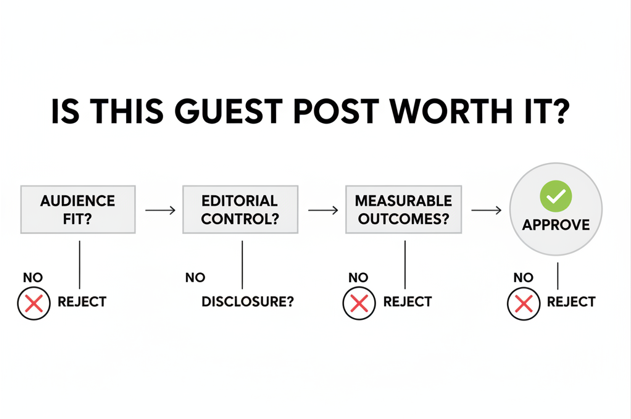
A decision framework: how to judge “worth it” before you spend
Use this quick framework to decide whether a paid guest post deserves budget.
1) Audience fit: would this site still be valuable without Google?
Ask yourself: if search engines vanished tomorrow, would you still want to appear on this site because its readers are your people? If the honest answer is “no”, the placement is probably an SEO gamble rather than a marketing asset.
2) Editorial integrity: does the publisher act like a publisher?
Healthy signs include clear submission guidelines, real editing, fact-checking, topical consistency, and a visible editorial identity. Red flags include “publish anything in 24 hours”, massive category sprawl, and pages that look like interchangeable advertorial shells.
3) Sponsorship clarity: is the relationship transparent?
In many jurisdictions, paid content needs disclosure. Even when local rules are fuzzy, transparency protects both sides: users understand why the content exists, and publishers show they aren’t trying to hide commercial intent.
4) Link policy: Are links user-first or sales-first?
The safest paid guest posts use links sparingly: one or two relevant references, branded or descriptive anchors, and appropriate link attributes when the relationship is commercial. If the publisher sells follow links with pre-approved anchors as the core product, the campaign is built on a fragile foundation.
5) Distribution: What happens after publication?
A post that disappears into a “sponsored” archive is rarely worth premium pricing. A post that is promoted in newsletters, social feeds, and category pages can outperform a dozen low-visibility placements.
How to do paid guest posting safely in 2026 (step by step)
Step 1: Define the non-SEO goal first
Pick one primary outcome: referral traffic, leads, credibility in a niche, or awareness in a new market. SEO can be a secondary benefit, but when it becomes the only KPI, quality usually collapses.
Step 2: Build a shortlist around relevance, not “metrics”
Authority metrics can help filter obvious junk, but they are not the strategy. A smaller set of highly relevant sites will usually outperform a bigger set of generic high-metric domains.
Step 3: Pitch a topic that belongs on the site
Strong pitches feel like they were designed for that publication’s readers. Instead of “Write about our product”, propose an angle that teaches, compares, or reveals something new—then use a short, tasteful mention of your brand where it genuinely helps.
Step 4: Agree on disclosure and link rules up front
Before anyone writes, align on:
- Whether the piece is labelled sponsored/partner content.
- Who edits and fact-checks the final draft?
- How many outbound links are allowed, and what link attributes will be used for commercial relationships?
- What happens if claims become outdated (update vs removal).
Step 5: Write for people who are not yet convinced
The biggest mistake in paid guest posts is writing for your own team instead of the publication’s audience. The best-performing sponsored pieces usually:
- Open with a real problem the reader cares about.
- Offer unique data, a framework, or a practitioner viewpoint.
- Use product mentions as examples, not as the entire narrative.
- Include limitations and trade-offs (yes, even in sponsored content).
Step 6: Measure outcomes beyond rankings
Track referral sessions, engaged time, newsletter sign-ups, assisted conversions, branded search lift, and direct responses from readers. If the post doesn’t drive any meaningful signal other than “a link exists”, you have learned something valuable: the placement was not a real distribution channel.
Step 7: Audit and prune
Even “good” paid guest posts can become risky if they accumulate in one section, drift off-topic, or become overly commercial. Schedule regular audits of placements and remove or update content that no longer meets your standards.
Publisher perspective: how to accept paid guest posts without harming your site
If you run a site that accepts paid contributions, 2026 rewards publishers who behave like editors, not like link brokers. The safest publisher playbook looks like this:
- Keep topic boundaries tight. If your site is about health, don’t suddenly publish casino, loans, or unrelated coupon content just because it pays.
- Maintain real editorial oversight. Edit aggressively, reject weak drafts, and avoid “hands-off” publishing that lets third parties run your CMS.
- Integrate sponsored content into your normal information architecture. Avoid building isolated “guest post zones” that look like a bolt-on SEO project.
- Set link limits and require sensible anchors. If a link doesn’t help the reader, it doesn’t belong.
- Label commercial relationships clearly. Transparency reduces risk with users, advertisers, and reviewers.
- Review legacy paid content. Noindex, update, or remove pages that no longer meet quality or relevance standards.
Publishers who do this can still monetize through sponsored content—while also protecting long-term organic visibility and reputation.
Marketer perspective: how to avoid wasting money (or buying risk)
From the buyer side, the most common failure mode is treating paid guest posting as a commodity. When you shop by price or “DA/DR” alone, you invite low-quality inventory.
Instead, ask questions that reveal whether the site is a real media asset:
- Who is the audience, and how does the publisher reach them (newsletter, social, community)?
- How are sponsored posts reviewed and edited?
- Where will the article live (category pages, internal links, search on-site)?
- What disclosure label is used?
- What is the link policy for commercial relationships?
If the answers are vague, or if the seller’s only language is “dofollow, permanent, guaranteed”, the deal is probably optimized for short-term SEO gambling rather than long-term marketing value.
Alternatives that often beat paid guest posting in 2026
Paid guest posting isn’t the only path to earned visibility. Depending on your niche, these alternatives can outperform it:
- Digital PR with newsworthy assets: original data, industry benchmarks, or expert commentary that journalists can cite.
- Partner co-marketing: webinars, joint reports, and community collaborations that bring direct audience overlap.
- On-site content upgrades: improve the pages you already own so they convert better and deserve more links naturally.
- Tool-led marketing: simple calculators, templates, or free utilities that attract organic mentions.
Often, the best strategy is hybrid: invest in one or two high-fit sponsored placements for distribution, and put the rest of the budget into assets that make earning links easier.
FAQ
Is paid guest posting “illegal” or always against guidelines?
Paid publishing is normal in the media. The risk comes from trying to disguise paid placements as purely editorial while using them primarily to manipulate search rankings. The safer approach is to be transparent, keep content relevant, and treat links responsibly.
Should you demand a follow link for every paid guest post?
In 2026, demanding follow links as a guaranteed deliverable often signals the wrong intent on both sides. If the placement is valuable because of the audience and trust, it can still be worthwhile even when links are labelled as sponsored or nofollow.
How many paid guest posts should a brand buy per month?
There is no universal number. A handful of strong, relevant placements can outperform dozens of low-fit posts. Start small, measure real outcomes, and scale only when you can maintain quality and topical consistency.
How do publishers price sponsored guest posts fairly?
Pricing should reflect editorial effort, audience reach, promotion, and the opportunity cost of allocating space in the publication. If pricing is driven mainly by “link metrics”, the model tends to drift toward link brokerage rather than publishing.
Bottom line
Paid guest posting can be worth doing in 2026, but only when it behaves like publishing: relevant topics, real editorial control, clear disclosure, and value to readers. If it behaves like a link scheme—off-topic, mass-produced, and anchor-driven—the risk and waste rise quickly.
If you’re considering paid guest posting this year, pick one publisher you truly want to be associated with, pitch a topic that belongs there, and measure success like a marketer—not like a link buyer.