
Many companies regard SEO (search engine optimization) and user experience (UX) as distinct areas. For instance, most people associate SEO with improving a website’s search rankings, and associate UX with how easy it is to navigate through your website (a.k.a., how much fun it is for users to visit).
Actually, SEO and UX have a very close relationship.
Search engines are no longer just matching keywords to the search queries users are performing. Today, they look at how users interact with websites, the speed of the pages, how easily users can find what they want, and if the overall experience satisfies users’ search intent.
This means that a website can not be successful through just SEO anymore either. Likewise, a beautiful website can be terribly difficult to find if it does not adhere to the best practices of SEO.
To bridge the gap of these 2 different objectives, you will need to perform an extensive website audit.
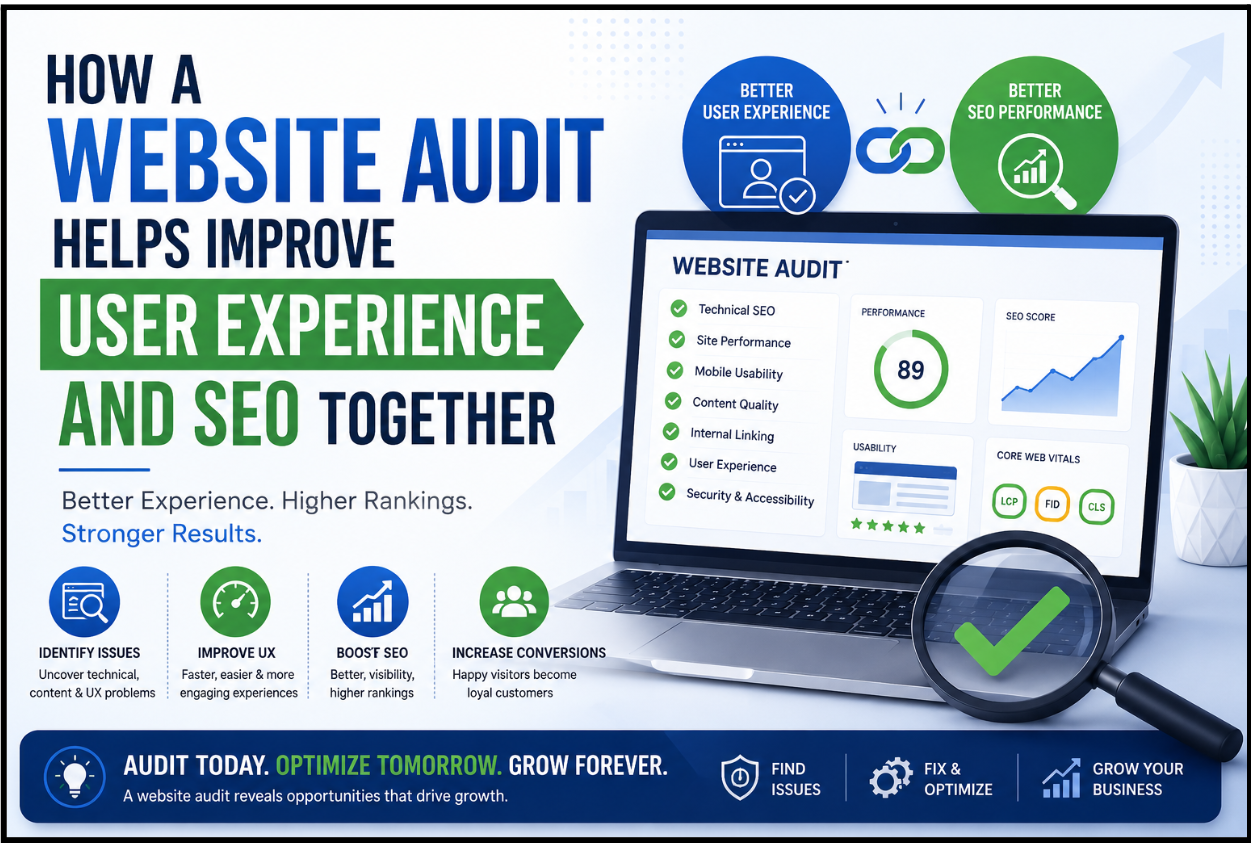
Conducting an audit of your website will identify the health of your website from different angles — including technical SEO, content quality, website architecture, website performance, usability, accessibility, and conversion optimization. An audit will be able to clarify the relationship between SEO and UX by identifying possibilities for growth of both at the same time.
When websites consistently conduct website audits, they are in a much better position to improve their search visibility, lower bounce rates, improve user interaction, and generate more qualified leads over time.
Why SEO and User Experience Go Hand in Hand
Years ago, SEO focused heavily on keywords, backlinks, and metadata. While these elements remain important, search engines now prioritize websites that deliver valuable experiences to users.
Visitors expect websites to:
- Load quickly
- Be easy to navigate
- Display correctly on mobile devices
- Provide useful and relevant information
- Make it simple to complete desired actions
When websites fail to meet these expectations, users leave.
Search engines monitor many of these engagement signals. Although they do not rely on a single metric, poor user experiences often correlate with lower search performance.
This is why improving UX frequently leads to stronger SEO performance as well.
A Website Audit Provides a Complete Performance Picture
One of the biggest mistakes businesses make is focusing only on rankings.
High rankings are valuable, but they represent only one part of website performance.
A website audit evaluates multiple factors simultaneously, including:
- Technical SEO
- Site speed
- Mobile responsiveness
- Navigation
- Content quality
- Internal linking
- Accessibility
- Conversion opportunities
Looking at these elements together allows businesses to understand why visitors behave the way they do and where improvements should be prioritized.
Identifying Technical Issues That Affect Users
Technical SEO is often viewed as something that only search engines care about.
In reality, technical issues directly affect visitors as well.
Examples include:
- Slow-loading pages
- Broken links
- Redirect loops
- Server errors
- Mobile display problems
These issues frustrate users while also making it more difficult for search engines to crawl and index a website.
Using a free website audit tool helps businesses quickly identify these technical problems before they negatively impact both rankings and customer satisfaction.
Addressing technical issues creates a stronger foundation for every other SEO and UX improvement.
Faster Websites Improve Rankings and Engagement
Website speed has become one of the most important factors in digital success.
Visitors expect pages to load almost instantly.
Even small delays can increase bounce rates and reduce conversions.
A website audit measures performance across important speed indicators, helping businesses identify bottlenecks such as:
- Large image files
- Unoptimized scripts
- Excessive HTTP requests
- Poor server response times
Improving page speed benefits everyone.
Users enjoy smoother experiences, while search engines recognize the improved performance.
Better Navigation Helps Search Engines and Visitors
Navigation is one of the most overlooked aspects of website optimization.
Visitors should always know:
- Where they are
- Where they can go next
- How to find important information
Search engines rely on this same structure to understand relationships between pages.
A website audit reviews:
- Menu organization
- Navigation hierarchy
- Breadcrumbs
- Internal linking
- Content categorization
Clear navigation improves usability while making websites easier to crawl.
Mobile Optimization Is No Longer Optional
Mobile devices now generate a significant share of website traffic across nearly every industry.
Unfortunately, many businesses still discover through audits that their websites have:
- Small text
- Poor spacing
- Slow loading
- Broken layouts
- Difficult navigation
A poor mobile experience leads to frustrated visitors and lower engagement.
Search engines also prioritize mobile-friendly websites.
Website audits help identify these problems before they affect business performance.
Content Quality Shapes User Experience
Visitors come to websites looking for answers.
If content fails to satisfy their needs, they leave quickly.
A website audit evaluates content based on:
- Accuracy
- Relevance
- Readability
- Search intent
- Freshness
- Depth
Improving content quality benefits SEO by increasing topical authority while improving user experience through better information.
Rather than creating more content, businesses often achieve stronger results by improving existing pages.
Internal Linking Improves Website Usability
Internal links help visitors discover additional resources while helping search engines understand website structure.
Many websites suffer from:
- Orphan pages
- Weak linking structures
- Missing contextual links
Website audits reveal these opportunities.
Better internal linking encourages visitors to explore more pages while distributing authority across the website.
This contributes to both higher engagement and improved rankings.
Website Accessibility Supports Better Experiences
Accessibility is becoming an increasingly important aspect of website quality.
Accessible websites are easier for everyone to use, including visitors with disabilities.
A website audit may identify issues such as:
- Missing image descriptions
- Poor color contrast
- Keyboard navigation limitations
- Improper heading structures
Improving accessibility expands audience reach while creating cleaner website structures that search engines can interpret more effectively.
Lower Bounce Rates Through Better Experiences
Bounce rate alone is not a ranking factor, but high bounce rates often indicate that users are not finding what they expected.
Website audits examine factors contributing to early exits, including:
- Irrelevant content
- Slow pages
- Confusing layouts
- Poor readability
- Weak calls to action
Improving these areas encourages visitors to spend more time exploring the website, increasing opportunities for conversions.
Conversion Optimization Starts With Understanding User Behavior
Driving traffic is only one objective.
Businesses ultimately want visitors to become:
- Customers
- Leads
- Subscribers
- Clients
Website audits evaluate conversion pathways by analyzing:
- Landing pages
- Forms
- Call-to-action placement
- Navigation flow
- Trust signals
Improving these elements enhances user experience while maximizing the value of organic traffic.
Why Enterprise Websites Require Comprehensive Audits
Large organizations often operate websites containing thousands of pages.
Managing consistent user experiences across such large platforms presents unique challenges.
Many enterprises partner with an enterprise SEO agency to conduct detailed audits that evaluate technical performance, content quality, scalability, and user experience across multiple business units.
Enterprise-level audits help organizations maintain consistency while supporting long-term SEO growth.
Measuring User Engagement Through Website Audits
A successful website is not measured solely by rankings or traffic. It is also evaluated by how visitors interact with its pages.
Website audits provide valuable insights into user engagement by examining metrics such as:
- Average session duration
- Pages viewed per visit
- Exit pages
- Navigation paths
- Click behavior
These metrics help businesses understand whether visitors are finding the information they need or encountering obstacles that cause them to leave.
For example, if users consistently exit a service page without taking action, the issue may not be a lack of traffic but rather unclear messaging, weak calls to action, or poor page design. Similarly, if visitors abandon the website after viewing only one page, it may indicate missing internal links or content that does not align with their search intent.
By reviewing engagement patterns during a website audit, businesses can identify opportunities to create a smoother user journey that supports both SEO performance and business objectives.
Core Web Vitals and Their Role in SEO and UX
Core Web Vitals have become an important part of evaluating website performance.
These metrics focus on real user experiences by measuring how quickly a page loads, how responsive it is to user interactions, and how visually stable it remains during loading.
A website audit evaluates these performance indicators to determine whether a website meets modern expectations.
Common issues include:
- Delayed loading of primary content
- Buttons or links that respond slowly
- Unexpected layout shifts while pages load
Improving Core Web Vitals enhances user satisfaction while strengthening technical SEO.
Businesses that consistently monitor these metrics are better equipped to maintain search visibility as search engines continue prioritizing page experience.
Website Audits Improve Content Discoverability
Creating high-quality content is only valuable if visitors and search engines can easily find it.
Many businesses unknowingly publish valuable articles, product pages, or service pages that receive little visibility because of structural issues.
A website audit identifies problems such as:
- Deep page hierarchies
- Weak category structures
- Missing navigation links
- Poor internal search functionality
- Inconsistent URL organization
Improving content discoverability benefits users by reducing the effort required to find relevant information.
At the same time, search engines gain a clearer understanding of the website’s structure, making it easier to crawl and index important pages.
Improving Trust Through Better Website Experiences
User trust is an essential component of long-term SEO success.
Visitors are more likely to engage with websites that appear professional, secure, and easy to use.
A website audit helps identify trust-related issues such as:
- Outdated design elements
- Missing HTTPS implementation
- Broken images
- Inconsistent branding
- Poor readability
- Confusing layouts
Although these issues may seem unrelated to SEO, they influence user behavior and conversion rates.
A trustworthy website encourages visitors to spend more time exploring content, complete inquiries, and return in the future.
Website Audits Support Better Decision-Making
One of the greatest advantages of a website audit is that it replaces assumptions with measurable data.
Rather than making changes based on opinions, businesses gain objective insights into what is working and what needs improvement.
Audit findings can help prioritize initiatives based on:
- Business impact
- Technical urgency
- User experience improvements
- SEO opportunities
- Resource availability
This structured approach reduces wasted effort and ensures optimization activities deliver measurable value.
Using Website Audits for Smarter SEO Budget Planning
SEO investments vary significantly depending on website size, competition, and technical complexity.
Without understanding current website conditions, budgeting becomes difficult.
A website audit helps identify:
- Technical improvements
- Content optimization requirements
- Development priorities
- Ongoing maintenance needs
Many businesses combine these findings with an SEO cost calculator to estimate future SEO investments more accurately.
Instead of relying on generic pricing estimates, organizations can align budgets with the actual work required, making long-term SEO planning more predictable and cost-effective.
Continuous Website Audits Drive Continuous Improvement
Websites are never static.
New pages are published, products change, technologies evolve, and search engine algorithms continue to develop.
As websites grow, new issues naturally emerge.
Regular website audits help businesses:
- Detect technical problems early
- Maintain content quality
- Improve navigation
- Monitor user experience
- Adapt to evolving SEO best practices
Rather than waiting for rankings or traffic to decline, organizations can proactively improve website performance through ongoing evaluation.
This continuous improvement mindset supports sustainable growth over the long term.
Common Signs Your Website Needs a New Audit
Many businesses delay website audits until performance problems become obvious.
However, several warning signs indicate that a fresh audit should be performed sooner.
These include:
- Declining organic traffic
- Lower conversion rates
- Increased bounce rates
- Website redesigns
- Slow page loading
- Major content updates
- Expanding into new markets
- Frequent technical issues
Conducting an audit before these challenges become severe allows businesses to address problems while they are still manageable.
Building a User-Centered SEO Strategy
Modern SEO is no longer about optimizing websites exclusively for search engines.
Instead, successful SEO strategies focus on providing valuable experiences that satisfy users while meeting search engine quality standards.
A website audit plays a central role in this process by revealing how technical SEO, content quality, website structure, and usability work together.
Businesses that adopt a user-centered approach often experience benefits such as:
- Higher search visibility
- Better engagement
- Increased trust
- Improved lead generation
- Stronger customer retention
These outcomes demonstrate that SEO and user experience are not competing priorities but complementary elements of digital success.
Conclusion
SEO and user experience are more interconnected today than ever before.
Search engines increasingly reward websites that are fast, accessible, easy to navigate, and capable of providing valuable information that satisfies user intent.
A website audit serves as the foundation for achieving these objectives by identifying technical issues, usability challenges, content gaps, and optimization opportunities across the entire website.
Whether businesses begin with a free website audit tool, collaborate with an enterprise SEO agency to manage large-scale optimization, or use an SEO cost calculator to forecast future investments, the audit remains the starting point for smarter decision-making.
Organizations that regularly evaluate both user experience and SEO performance create websites that not only rank well in search engines but also deliver meaningful experiences that convert visitors into long-term customers.
Frequently Asked Questions
1. How does a website audit improve user experience?
A website audit identifies issues such as slow loading speeds, broken links, confusing navigation, mobile usability problems, and accessibility challenges that can negatively affect visitors. Addressing these issues creates a smoother and more engaging browsing experience.
2. Can improving user experience also improve SEO?
Yes. Better user experiences often lead to improved engagement, easier website navigation, faster loading times, and higher-quality content, all of which contribute to stronger search engine performance.
3. How often should businesses perform a website audit?
Most businesses should perform a comprehensive website audit at least twice a year. Enterprise websites or rapidly growing businesses may benefit from quarterly audits to identify issues before they impact performance.
4. Why is technical SEO included in a website audit?
Technical SEO ensures that search engines can efficiently crawl, index, and understand website content. It also improves website performance, page speed, and usability, which directly influence the user experience.
5. Is a website audit useful for websites that already rank well?
Absolutely. Even high-performing websites develop technical issues over time. Regular audits help maintain rankings, improve user satisfaction, and uncover new opportunities for growth before competitors gain an advantage.