
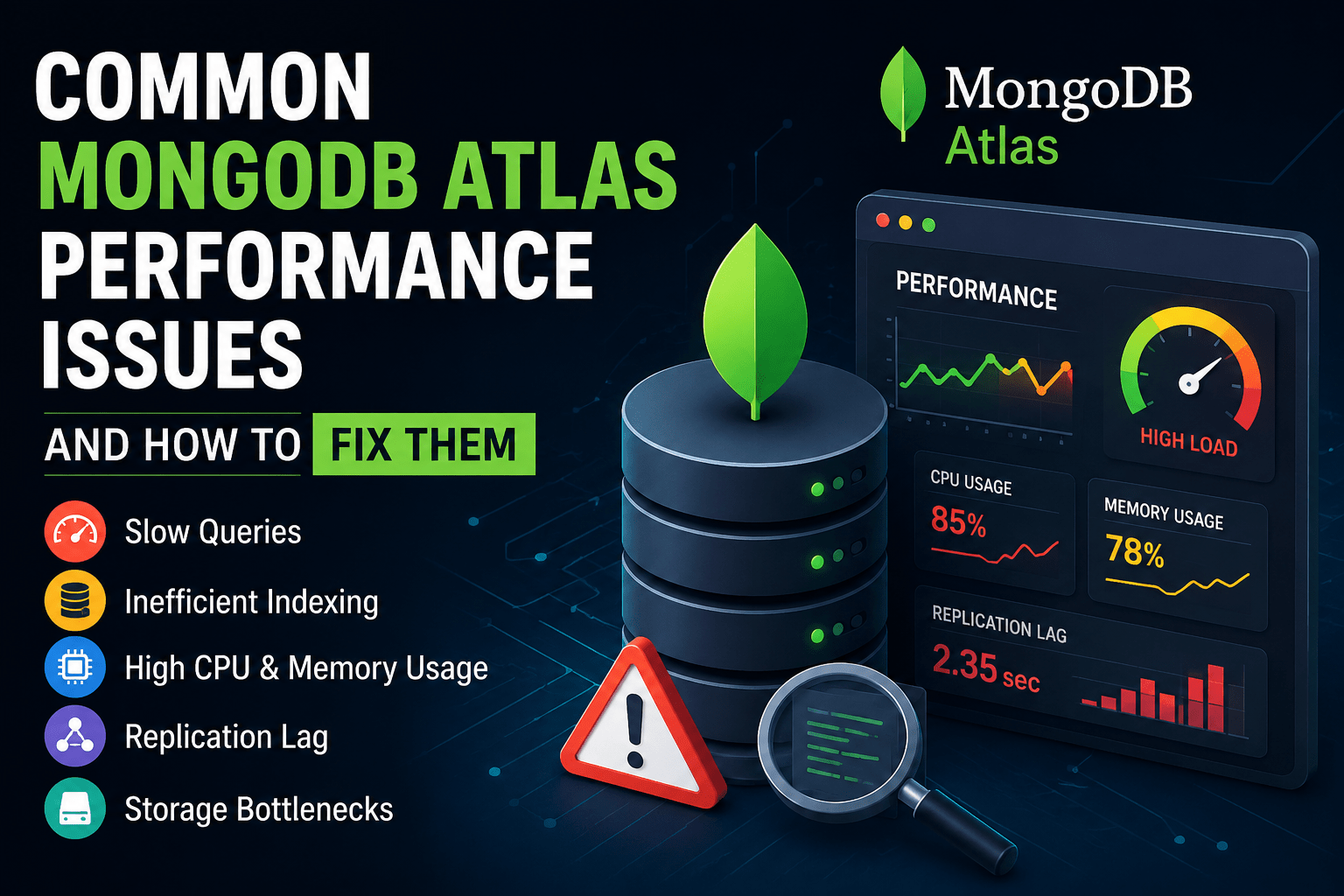
Modern businesses lean heavily on databases to manage applications, customer information, analytics, and real-time operations. As organizations scale their cloud-based applications, it has become critical for them to run their databases optimally. While MongoDB Atlas is indeed a highly scalable and flexible cloud database platform, performance problems can crop up when these databases are not properly optimized.
These include slow queries, high resource utilization, replication lag, and inefficient indexes. Quite a few organizations have taken MongoDB managed services and MongoDB database support services, along with work by Mydbops, as a way to ensure highly stable and high-performing MongoDB environments.
The Importance of Optimizing Atlas for Performance
Application performance can readily affect the way we serve our customers, how they interact with our product or service, and how efficiently we operate as a business.
In conjunction with performance, slow response times can reduce worker productivity and create customer dissatisfaction via poor service. Further, those types of performance issues can also contribute to larger infrastructure costs due to the resources, such as CPU and Memory, used while responding slowly.
Common Reasons for Performance Issues with MongoDB
Some of the Most Common Reasons for Performance Issues with MongoDB Include
- Inefficient Querying
- Missing or Unused Indexes
- CPU and Memory Exhaustion
- Large Document Size
- Schema Misdesign
- Replication Delay
- Storage Bottlenecks
- Poor Resource Allocation
Companies leveraging MongoDB managed services can assist their organizations by proactively detecting and addressing these performance issues prior to production workload impacts.
MongoDB Atlas Has Several Common Performance Problems
1. Slow Query Performance
In an Atlas application, slow query performance is common when a procedure requires a lot of data from the database and when multiple users are running a procedure concurrently.
Reasons for Slow Query Performance
Some of the reasons why a query that retrieves large amounts of data may be slow include:
- Missing indexes
- Very complicated aggregation query statements
- Very large data sets that need to be scanned
- Non-optimized query statements
- Excessive sorting operations
Resolution for Slow Query Performance
The way to resolve slow queries in Atlas is to do the following:
- Create proper indexes for your most frequently used queries
- Use query profiling tools to analyze your queries for potential performance bottlenecks
- Limit unnecessary retrieval of data from the database
- Optimize the performance of the aggregation statements
- Avoid full collection scans as much as possible
- Work with a professional service that specializes in providing ongoing monitoring and optimization of your relational database query performance
2. Indexing Deficiencies
Lack of adequate indexing along with over-indexing, can impact the overall performance of a MongoDB database. Although indexes are a critical component in the performance of any database.
Common Indexing Issues
- Missing indexes for frequent fields searched
- Duplicate indexes
- Unused indexes are creating extra storage space
- Large compound indexes affecting write performance
Index Improvement Recommendations
- Review the usage of indexes regularly
- Delete any duplicate and unused indexes
- Create compound indexes carefully
- Use covered queries whenever applicable
With expert MongoDB managed services, any organization will be able to execute and manage an efficient indexing strategy with less storage burden.
3. High Resource Utilization CPU and Memory
High processing resource use can diminish performance and result in unavailability for application purposes.
Some Common Causes Include
- High workload querying
- Inefficient application logic
- Ineffective indexing structure
- Large number of aggregations
- Not enough cluster resources
Ways to Optimize Performance
- Upgrade your cluster resources if needed
- Optimize the queries that cost the most to run
- Minimize unnecessary workload activity
- Keep track of the resources your database is using constantly
- Use caching otherwise you are overspending your money
Organizations such as Mydbops provide proactive monitoring and tuning solutions for CPU and Memory related problems.
4. Replication Issues
The issue of replication lag occurs when the secondary nodes cannot keep up with their primary in a replica set. Data availability and failover depend on how fast secondary nodes replicate changes made to the primary node.
Causes of Replication Lag
- Heavy write usage
- Network latency
- Poor file system performance
- Resource constraints
How to Reduce Replication Lag
- Upgrade hardware
- Optimize write operations for performance
- Remove unnecessary indexes
- Continuously monitor the condition of your replicas
- Use reliable MongoDB database support services to help replicate fast in production
5. Large Document Issues
Large Documents may negatively impact the reading and writing performance of the storage engine within your MongoDB database.
Large Document Issues Include
- Large document memory utilization
- Longer response times while executing queries
- Increased amount of time required to transfer data over the network
- More storage utilization for both large and small documents
Best Practices to Follow in Order to Manage Large Document Sizes
- Keep the structure of your documents compact
- Avoid having large amounts of unnecessary nested data
- When possible archive older records
- If you have a large document, consider splitting the document into smaller documents stored as separate MongoDB collections
Significance of Monitoring MongoDB Atlas Performance
To be able to detect potential problems before they reach a critical state, it is necessary to continuously monitor your systems for the following areas of concern:
- Execution times of queries
- Utilization of CPU
- Memory usage
- Utilization of disk space
- Replication performance
- Delay in network communication
Businesses that invest in professional MongoDB managed services benefit from advanced monitoring tools and expert database analysis.
Guidelines on Optimizing MongoDB Atlas Performance
Schema Design of Your Database
Optimizing your schema design will provide optimal resource usage when executing queries.
Recommendations
- Design your collections according to how your application will access these documents
- Do not nest documents too deep
- Use appropriate data types
- Do not allow document sizes to grow too big
Scale Your Infrastructure as Needed
As your application gains users, your infrastructure will need to increase with those users.
Recommendations
- Make sure you have selected the correct configuration for your database classes
- Enable autoscale when needed
- Monitor the increase in workload only because you will be billed
- Balance your number of reads versus writes
Ongoing Maintenance of Your Database
Performing regular maintenance will help keep the performance of your database at its best for the long run.
Maintenance Tasks
- Look for slow queries
- Rebuild fragmented indexes when necessary
- Archive old data
- Review your database logs frequently
Mydbops is a trusted partner to optimize your database to evolve with changing workloads.
Reasons to Work with Mydbops for MongoDB Support
Managed services for your organization’s MongoDB application environment require expert knowledge of the MongoDB program, especially if it is an enterprise-level application with high-volume traffic and large datasets.
Mydbops provides enterprises with expertly managed MongoDB managed services, which include advanced capabilities to assist in improving performance, scalability, and reliability.
The Core Services Provided by Mydbops for MongoDB
- Performance Optimization
- Query Tuning
- Monitoring and management of the database
- Backup and restore capabilities
- Set up of high availability
- Security hardening
- Migration of the database
With considerable and deep experience within the field of MongoDB technologies and managing databases for many businesses, Mydbops gives customers the ability to fix performance issues efficiently with a strong focus on improving operational stability.
In Summary
As organizations scale cloud-based native applications, the importance of maintaining database performance becomes more important. MongoDB Atlas provides true cloud scalability and power, but it may still present performance issues such as slow execution of queries due to improper indexing or structure, excessive replication lag, and excessive consumption of hardware resources.
When the right optimization practices are followed along with Mydbops expert MongoDB consulting services and MongoDB database support services, enterprises can significantly improve the overall efficiency of their databases and the reliability of their applications.
To learn more about how Mydbops can help optimize your MongoDB Atlas application, please contact Mydbops.