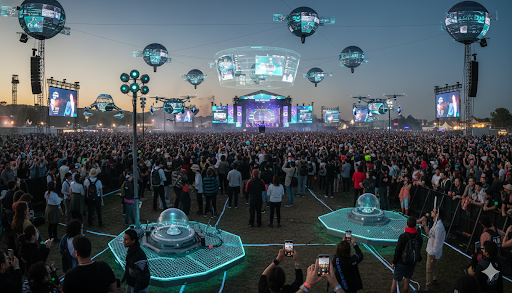
Running a large event is one thing. Running it well when thousands of people show up at the same time is a completely different challenge. Crowd density changes everything. What works fine at a 200-person gathering starts falling apart at 5,000. Registration slows down. Entry points get chaotic. Staff get overwhelmed. Attendees lose patience. And the organisers are left with firefighting instead of hosting. The good news is that the right event registration solutions can handle all of this without breaking a sweat. Technology built specifically for high-density, on-ground events exists today, and it covers every part of the experience from the moment someone signs up to the moment they walk out. Here is a look at what that technology actually looks like in practice.
On-Ground Event Tech Is Not One Tool, It Is A Whole System Working Together
A lot of organisers think about event technology as individual tools. A registration form here, a badge printer there. But when crowds are large, that patchwork approach is where things go wrong. What you actually need is a connected system where every piece talks to the other. That is the foundation of what modern event registration solutions are built on. When your registration data flows directly into your check-in setup, your badging system, your access control, and your analytics, the whole operation becomes much easier to manage. Nothing falls through the cracks. No one has to manually carry information from one place to another. And when something unexpected happens on event day, the system adjusts without needing a new process built from scratch. This is exactly what Dreamcast offers.
Let us walk through each layer of that system.
Where It All Starts: Event Registration System And Ticketing
Before anyone walks through your venue doors, they come through your registration process. A good event registration system handles this in a way that makes life easier for both the organiser and the attendee. Custom registration forms, secure payment gateways, and automated confirmations are the basics. But what matters at scale is how that data is stored and accessed later. If your registration data is clean and synced in real time, your on-ground team can pull up any attendee record in seconds. No hunting through spreadsheets, no repeated data entry.
For events that sell tickets, an event ticketing platform that integrates with your on-ground setup is equally important. Dreamcast offers both online and on-site ticketing options with POS systems and real-time syncing, so whether someone bought a ticket three weeks ago or walks up and buys one at the venue, the system knows about them and treats them the same way.
Getting People In: The Event Check-In System
This is where most large events either win or lose the crowd. An event check-in system that cannot handle peak arrival time is a serious problem. Imagine your conference starts at 9 AM and 3,000 people are trying to get in between 8:30 and 9:15. If each person takes even 45 seconds to find and verify, that is a very long queue.
Dreamcast’s check-in setup addresses this by using QR code scanning, facial recognition turnstiles, RFID and NFC readers, self-serve kiosks, and volunteer-managed desks all working at once.
– Attendees scan their QR code from a confirmation email or their mobile device and the system validates them instantly.
– Turnstile gates connected to the system allow contactless entry in under five seconds. – Walk-ins can register on the spot through the same kiosks, so there is no separate slower process for them.
The whole thing is designed to move people through quickly without sacrificing security or accuracy.
Onsite Badging That Works At Scale
Onsite event badges are not just about printing names on paper. At large events they carry a lot of responsibility. They control session access. They help exhibitors and sponsors identify the right attendees. They make networking less awkward because people do not need to introduce themselves from scratch. And increasingly, they serve as data collection tools through QR codes and RFID chips embedded in the badge.
Dreamcast’s badging solution offers on-demand printing, which means badges are printed as attendees arrive rather than beforehand. This handles last-minute registrations and walk-ins cleanly. Organisers can customize the badge design to match the event brand, add sponsor logos, include QR codes for contact sharing, and choose from PVC badges, paper badges, or adhesive labels depending on the event format. The printers are high-output and built to handle sustained volume during peak check-in windows. Onsite event badges with QR codes also allow attendees to share their contact details just by scanning each other’s badge, which adds real value at any networking-heavy event.
The Mobile Event App As Your On-Ground Command Centre
One tool that often gets underused at large in-person events is the mobile event app. Most people think of it as something for virtual or hybrid events, but it is genuinely powerful on the ground too. Dreamcast’s mobile event app gives attendees access to the event schedule, speaker information, venue maps, and real-time updates all in one place. Push notifications let organisers communicate with the entire crowd instantly. Session changes, room shifts, announcements, they all go out in seconds.
For organisers, the app provides real-time attendance data and footfall insights so you can see what is working and what is not while the event is still happening. AI-powered matchmaking features help attendees find the right people to connect with based on their profiles and interests. At a high-density event where thousands of conversations are possible, that kind of guided networking makes a real difference to the quality of connections people walk away with.
Real-Time Data And Post-Event Reporting
Running a large event without data is a bit like driving without a dashboard. You might get there, but you will not know much about how the journey went. Dreamcast’s platform captures attendance data, badge printing volumes, session footfall, and engagement metrics throughout the event. This feeds into a live dashboard that the organising team can monitor in real time.
After the event, detailed reports can be generated in PDF format and the data integrates with CRM and marketing platforms. This means your sales and marketing teams can follow up with attendees quickly and intelligently. They know who attended which sessions, who engaged with which sponsors, and who might be the right fit for a follow-up conversation.
Conclusion
Managing a high-density crowd well is not just an operational challenge. It is a trust challenge. Attendees are giving you their time and often their money, and they expect a smooth experience in return. The right event registration solutions, combined with a connected on-ground tech stack, make it possible to deliver that at any scale. From a reliable event registration system and a high-throughput event check-in system, to personalised onsite event badges, a practical mobile event app, and a flexible event ticketing platform, Dreamcast brings all of these pieces together in one place. If you are planning a large-scale event and want the ground operations to actually run the way you planned them, that kind of end-to-end technology is where the conversation should start.
About the Author