Want to know how to truly maximise your Kia’s performance? Looking to see what aftermarket parts really do? You may already be thinking to yourself: “Should I upgrade my turbocharged Kia?”
As a Kia owner, you already have a great base in your hands if you have a turbocharged Kia. They are responsive, efficient and surprisingly capable out of the box. As with most modern cars, however, manufacturers tune them conservatively such that they offer a balance between fuel economy, emissions, and longevity. That’s where there is room for improvement, and that’s where aftermarket parts come in.
We’ll take a look at the best aftermarket turbo parts for your Kia, ranging from performance intercoolers to ECU tuning solutions. We will look at what upgrades are best value for money, explore reliability upgrades and what gains you can reasonably expect to achieve. You can find practical tips for drivers in Australia and driving style in both a Cerato GT, Stinger and turbocharged Sportage.
Understanding Your Kia’s Turbocharged Engine
How Kia Turbo Engines Work
Kia’s turbocharged engines provide a way for exhaust gases to spin a turbine that forces more air into the combustion chamber. The more air, the more fuel can be burned, and the more power without requiring a larger engine. It’s smart design for great power from modestly sized engines.
The 1.6-litre T-GDi, found in models such as the Cerato GT, pumps out around 150kW, while the twin-turbocharged 3.3-litre V6 engine found in the Stinger GT produces more than 270kW. These are good numbers, but it’s possible to do better with the right modifications.
Common Performance Limitations in Stock Kia Turbos
The emphasis in factory turbos is not on performance, but on reliability and emissions compliance. For example, the stock intercooler is enough for normal driving, but may fail during hot summers in Australia or on the race track. The factory airbox doesn’t allow for the free flow of air either, and the exhaust system generates back pressure, which reduces the efficiency of the turbo.
Are Aftermarket Parts Worth It for Kia Turbo Models?
Benefits of Upgrading vs Staying Stock
When you stay stock, it’s easy to keep things simple: Your warranty is still in place, and everything still functions exactly as the engineers designed it. But upgrading brings better throttle response, greater power, faster turbo spool times, and may lead to enhanced enjoyment of the ride.
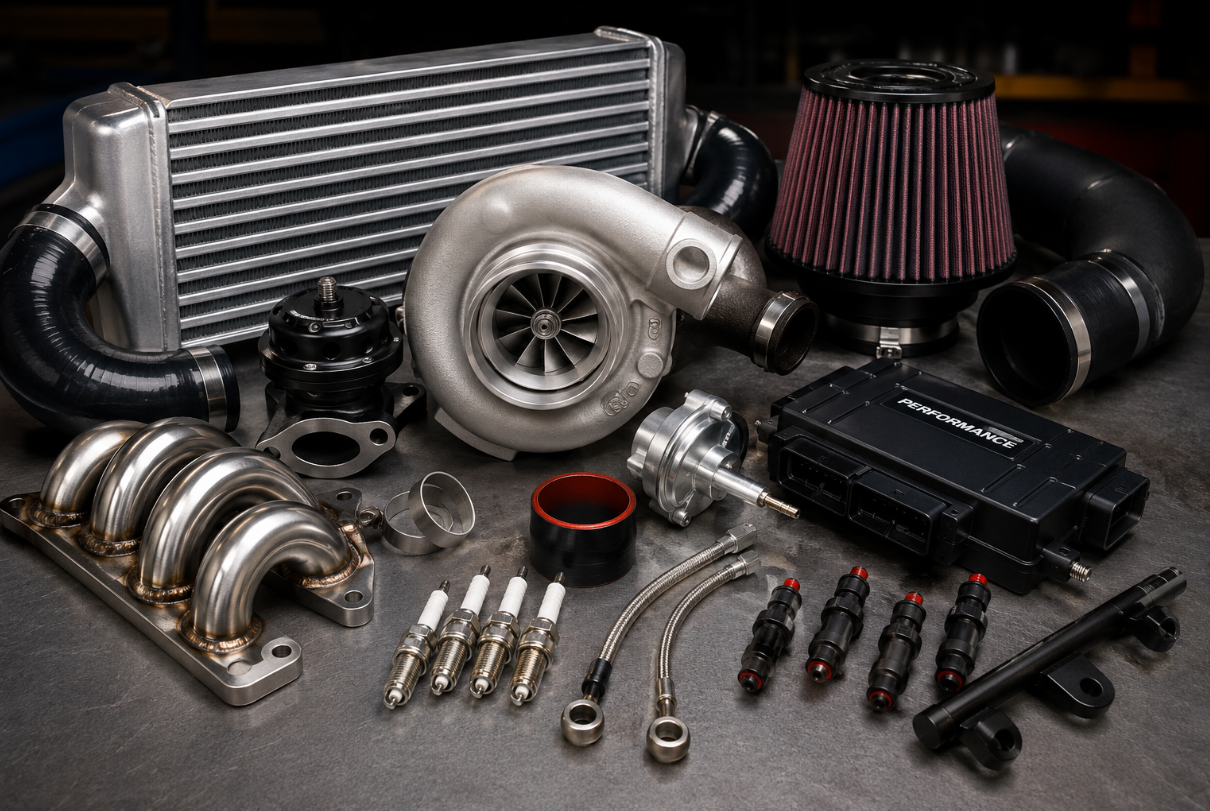
Aftermarket parts for turbocharged vehicles are often made of better materials than the original equipment manufacturer (OEM) parts. There are larger cores and better fin design for performance intercoolers. High-flow downpipes remove restrictions that stop your turbo from reaching its potential performance. These enhancements add on top of each other, which makes the car a lot more responsive.
What Performance Gains Can You Realistically Expect?
Truth be told, you’re not going to double up on your horsepower with bolt-on work, and the same applies to nearly every other part of your car. But if a combination of multiple quality enhancements is made, on most Kia turbo engines they can achieve 15-25% more power. However, a Cerato GT can potentially be improved by 20–30kW using a good intake, downpipe and ECU tune.
These torque gains are more noticeable in the light-duty application. Improved mid-range pull facilitates overtaking, and highway merging situations become less stressful. Most drivers are more concerned about these practical advantages than with top speed.
Top Aftermarket Turbo Parts for Kia Vehicles
Performance Intercoolers: Do They Make a Difference?
Absolutely. Under sustained load, performance intercoolers keep intake temperatures cooler than if they were allowed to heat up, removing the power-robbing heat soak. The stock intercoolers of most Kias are good for normal driving usage but fail to perform well on track days or when driving with zest in a canyon.
More modern units from other manufacturers such as Process West or Mishimoto provide much larger core volume and higher efficiency. This is consistent power delivery, especially important in hot summer days, which a lot of Australians will experience.
Cold Air Intake Systems for Improved Airflow
Cold air intakes provide a more unrestricted airflow design to give your turbo more breathing room than the factory airbox. In addition to its performance benefits, many owners also love the new induction sound, or the signature whoosh when you accelerate.
Brands such as K&N, AEM and Injen will generally add 5-10kW to the power while enhancing throttle response. It’s easy to install, which is great for the first mod for people who have not been through the process before.
High-Flow Downpipes and Exhaust Upgrades
The downpipe links your turbo to your exhaust and can have a marked effect on turbo performance. Stock downpipes employ restrictive catalytic converters which generate back pressure. High-flow alternatives diminish this restriction, thereby enabling exhaust gases to flow out more easily.
This mod is usually the most obvious one, and is frequently used in conjunction with ECU tuning for enhanced power. Better gains of 15-25kW will be seen for most applications. Just make sure you select a cat-back downpipe that will keep you road legal in Australia.
Upgraded Blow-Off Valves and Wastegates
The aftermarket blow-off valves help the turbo respond better and give that sound that most fans enjoy, known as “pshhh. These aftermarket blow-off valves give the turbo a better response and that signature “pshhh” sound that fans love! Although gains are small, improved valve response means a decrease in turbo strain when opening or closing the throttle rapidly.
If you’re tuning your ECU for increased boost pressure, then upgraded wastegates will be more accurate in their boost control. Good reliability with Quality units from an Australian company – Turbosmart.
ECU Tuning and Performance Chips
But perhaps the most cost-effective modification is ECU tuning. Professional tuning modifies fuel delivery, ignition timing and boost pressure to maximise performance. Reliability is very good with modern tunes, and gains are likely to be 15-20%.
Flash tuning tools such as a COBB Accessport can be used to switch maps and are convenient for going back to stock settings before going to the dealer. Custom DYNO tuning tends to be more effective, but is more expensive in terms of initial setup.
Reliability-Focused Upgrades: Parts That Last
Reinforced Turbo Lines and Hoses
Stock silicone hoses and boost lines can deteriorate over time, especially with increased boost pressures. When upgraded lines are used, they have greater heat resistance and stop boost leaks that cause performance loss. Though it may be a small price to pay, it prevents headaches in the future.
Oil Catch Cans and Engine Protection
Oil catch cans collect oil fumes before they get into your intake system. Carbon deposits on intake valves are especially prevalent in direct injection engines, such as those used in today’s Kias. A good catch can can greatly minimise this problem.
How to Improve Kia Turbo Longevity with Quality Parts
Buying quality parts from well-known manufacturers guarantees lasting changes. With modified vehicles, regular maintenance is even more crucial; quality oil, frequent changes and maintenance of the cooling system will keep things running smoothly.
Which Kia Models Benefit Most from Turbo Upgrades?
Kia Cerato and Cerato GT
The already vibrant Cerato GT is an excellent engine to mod. The aftermarket is relatively new and support continually increases, and better quality parts are becoming more available from Australian suppliers.
Kia Stinger Performance Modifications
The Stinger has huge modding potential, especially the twin-turbo version of the new 3.3-litre engine. This platform has a wide range of experience among Australian tuners, and quality upgrades are easily available.
Kia Sportage and Seltos Turbo Enhancements
Simple modifications are beneficial to SUV owners who want more towing power or simply faster acceleration. With intake and tune modifications, the 1.6-litre turbo found in these vehicles can be very responsive.
Building Your Perfect Kia Turbo Setup
We have covered a wide range of possible aftermarket modifications in this guide that will enhance the performance and reliability of your Kia. The possibilities are quite interesting, from cold air intakes that allow your turbo to breathe easier to ECU tuning that can unlock some extra potential.
This will vary depending on your requirements, financial constraints, and driving habits. Begin with modifications that are the most cost-effective, which is usually ECU tuning and intake modifications, then add on those. With performance parts, quality is always better than quantity.
Whatever you decide to do, keep in mind that it should be fun to modify. Do your research, join Kia communities and deal with trusted suppliers who are aware of the local climate. Your turbocharged Kia has a lot of potential that hasn’t yet been tapped into—and you know how to tap it.