
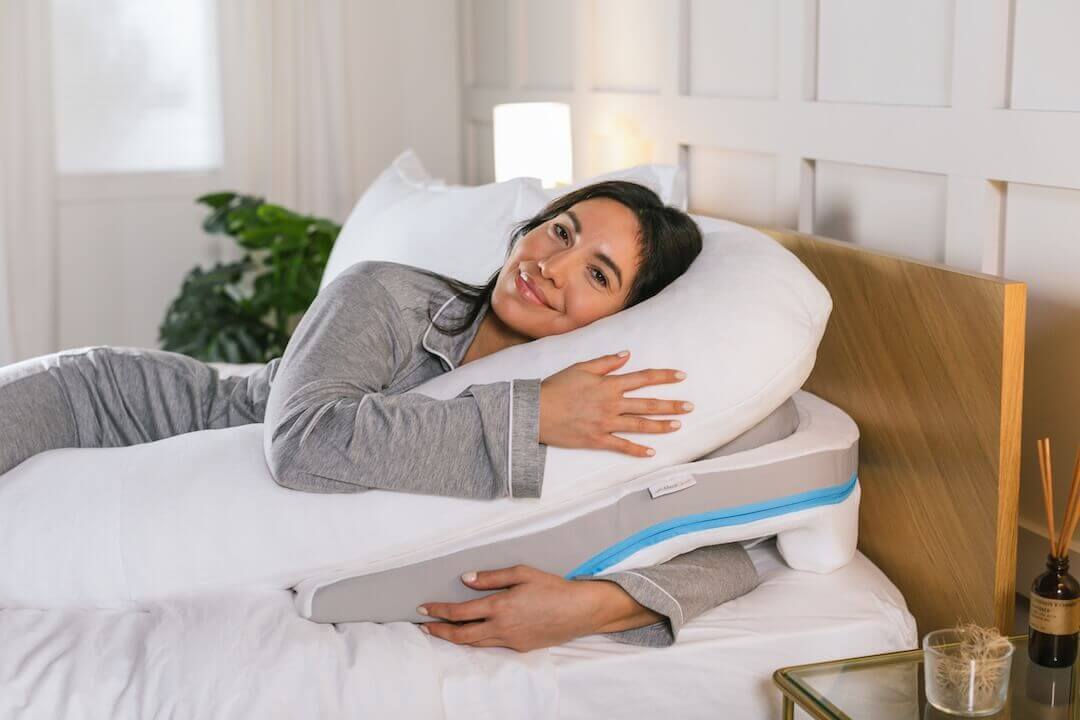

Waking up with a stiff neck can ruin your whole day. Often, the real issue is not your mattress. It is your pillow. A good pillow keeps your neck and head in a straight line with your spine.
That line helps your muscles relax so they can recover while you sleep. However, there is no single pillow that fits everyone. Your body shape, sleep style, and pain history all matter. So the best choice starts with knowing what your neck needs and what your night looks like.
In this guide, you will learn a clear process you can follow at home. You will also learn what to look for in loft, firmness, and fill. By the end, you will know how to shop with confidence for the best pillow for neck support for side sleepers.
Why Neck Support Matters
Your neck has a gentle curve. It holds up your head for hours each night. When your pillow is too high, your chin can tilt down. When it is too low, your head can drop back. Either way, your neck joints and soft tissue take stress. As a result, you may feel tight shoulders, headaches, or tingling in the morning. Proper support from the best pillow for neck support side sleeper does the opposite, as it keeps your airway open, and it reduces strain on your upper back. Plus, it can help you stay asleep since you do not need to keep shifting to get comfortable. So, before you focus on brands and price tags, it helps to focus on alignment.
Start With Your Sleep Position
Your sleep position is the main driver of pillow height and shape. If you sleep on your back, you usually need a medium loft. That means your head stays level without pushing forward. If you sleep on your stomach, you need a low loft or no pillow at all. That keeps your neck from twisting for hours.
Meanwhile, side sleeping often needs a higher loft because the space between the shoulder and head is larger. It also needs a pillow that fills that gap without forcing your neck up.
That is why many shoppers look for the best pillow for neck support for side sleepers. Even so, side sleepers still vary a lot. Your shoulder width and mattress softness change the gap. So use your position as a starting point and then fine-tune.
Understand Loft And Firmness
Loft means height. Firmness means how much a pillow resists your head weight. These two work together. A high loft pillow that is very soft can sink too much. A low loft pillow that is very firm can feel like a block. So you want a pair that holds your head in place while still feeling gentle.
A simple way to check is the neutral neck test. Lie in your usual position. Ask someone to look at your neckline. Your ear, shoulder, and hip should form a straight line for side sleeping.
For back sleeping, your nose should point to the ceiling and not toward your feet. If the line is off, then adjust the loft first. After that, adjust firmness so the pillow does not collapse during the night.
Match Loft To Your Shoulder Width
Shoulder width is the hidden factor many people miss. Wider shoulders need more loft. Narrower shoulders need less. However, the mattress also matters. A soft mattress lets your shoulder sink. That reduces the space your pillow must fill. A firm mattress keeps your shoulders higher. That increases the space.
You can measure this at home in a simple way. Stand against a wall and measure from the wall to the outside edge of your shoulder. That gives you a rough number. Then think about the sink. If your mattress is plush, take a little height away. If it is firm, add a little height.
Not only that, but your pillow should keep its height after a few minutes under pressure. Otherwise, it will feel fine at first and fail later. This is one reason the best pillow for neck support for side sleepers is often a pillow with steady loft and stable support.
Conclusion
Picking the right pillow is less about trends and more about fit. Start with your sleep position. Then check the loft and firmness together. After that, measure your shoulder width and your mattress’s feel.
Next, choose a fill that supports your neck and matches your comfort needs. Finally, consider shape and adjustability so you can fine-tune over time. When you test at home, focus on neutral alignment and on how you feel in the morning.
With small changes, you can often fix big problems. Most of all, remember that your neck needs steady support for hours at a time. When you use a clear process, you avoid guesswork and wasted money. That is how you find the best pillow for neck support, side sleeper, and also the best pillow for your body.