Understanding Curriculum Differences in Primary and Secondary Education
In every student’s life, starting school is a big step and shifting from primary to secondary school is also more important.
Howeve,r the question you must ask yourself is what is the difference between these two schooling systems?
Why are these schooling systems different from one another?
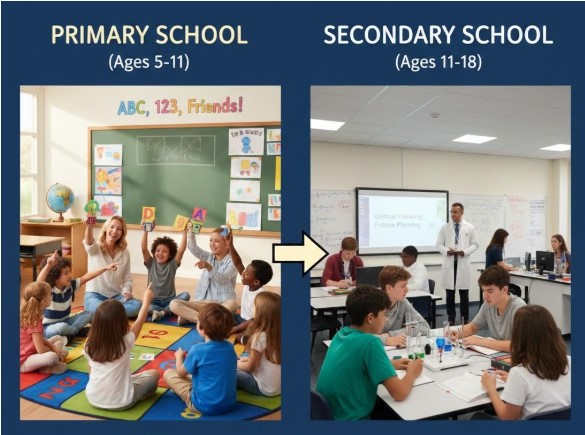
Primary school is junior school, and it is where the learning practice of a kid begins. In the junior school, kids usually learn the basics of ABC and 123s. On the other hand, creating friendships in a warm and positive setting.
On the flip side, secondary school, high school, or senior education is the process where students go deeper into specialised courses. Also in high school, pupils learn to develop critical thinking skills and plan for their future studies.
If you are a parent guardian aspiring educator or school administrator, this guide is for you.
The significance of grasping the difference?
Learning changes and shapes the backbone of a kid’s future. So, every parent, guardian and learner needs to grasp the structure of schooling.
Well, this helps them to make wise choices once obtaining admissions into schools or change between phases.
There are two stages of the education system, the primary and secondary learning. These two learning serve as its key pillars.
Moreover, every stage plays a key role in student life and shapes it in both academic and personal progress.
What is Primary Education?
The primary or junior education usually covers the first 5 years of a student’s life. It is basically the foundation stage and aim on creating basic skills. These are literacy, numbers and whole knowledge.
In the majority of cases, the class size at this level of learning is typically smaller. Because it is designed to get personalized attention for kids.
Subjects in Primary Schools
The junior learning system is aimed at teaching students the foundation concepts in plenty of fields.
Among the main subjects are as follows.
- English- In the junior level, English usually covers the basic grammar, vocab and sentence structure.
- Science- The science covers the foundation models of the natural world, such as plants, animals and weather.
- Math- The math covers the foundation skills such as adding, subtraction, multiplication and division
- Social Studies- In the social studies learners study the concepts of geography, history, and culture.
What is Secondary School?
Secondary schooling, high school, or senior is a broader education, it typically comprises the ages of 11 to 18.
In this stage, students learn more in-depth courses and it aim on more develop skills such as critical thinking. Also, the aim of this learning is to teach students about the future world of the workplace.
In addition, students as well prepare to write longer types of assignments.
Subjects in Secondary School
In the secondary school, the syllabus becomes more specialized and detailed. At this level, students can select subjects group depend in their interests and also their future career aims.
The compulsory subjects are English, Maths, science and Social Studies. Whereas the elective or specialization subjects include technology computing, art and design, business and commerce, and health and physical education.
The main aim of secondary learning is to teach students to apply conceptual learning and practical application. Also, teach them how to prepare for the exams.
Let puts in another way secondary learning change a student’s academic path and career goals.
Main differences between Primary and Secondary Schools?
| Aspect | Primary school | Secondary school |
| Age group | 5 to 11 | 11 to 18 |
| Purpose | Offer basic knowledge to students, such as ABC | Provide specialized knowledge to students and develop their critical thinking skills. |
| Subjects | Basic subjects such as English, Science, Social studies and math’s | Elective courses such as tech computing, art and design, business and commerce |
| Homework | Easy and less frequent | More tough and need critical thinking skills to solve it |
| Learning style | Holistic and play-based style | Focus on an independent learning style |
| Exams | Fewer and formal style | More exams and assessments on a daily basis |
| Level of duty | Teachers support kids closely | It encourage on more independence and time management |
Are you still confused and need professional help? In that case connect with an expert CIPD Assignment Help? They will help you from start to end. Also, they will teach you how to write quality papers. So, without wasting anytime you must reach out to them.
The role of teachers in both education systems
The one big difference changes both primary and secondary tutoring.
- Primary School- In the primary school, a similar group of kids is normally taught by the same teacher each day all along. So, this makes the perfect bond between tutors and students and they feel closer.
- Secondary School- While in both middle and high school, every class has its own tutor. There is as well plenty of different tutors who assist students in their studies in plenty of unique ways.
The Change from primary to secondary school
The change from elementary to secondary school is in my opinion a significant turning point in students life.
So you must embrace it. Since kids face new subjects, new tutors, and normally a new setting. So, the change from a familiar fostering space to a more organized and independent one is a big leap.
However, it is as well essential step for every kid. Below are some effective tips that you need to do from shifting from primary to secondary education.
- Prepare yourself- First of all, you need to discover the rules of your new school.
- Remain organized- Now you will need to maintain things in order by jotting down your daily tasks in a planner
- Make new friends- In order to excel in secondary education you need to be nice and make friends.
- Do not be afraid to help- If you need any help do not be afraid to reach out to your tutors.
About the Author