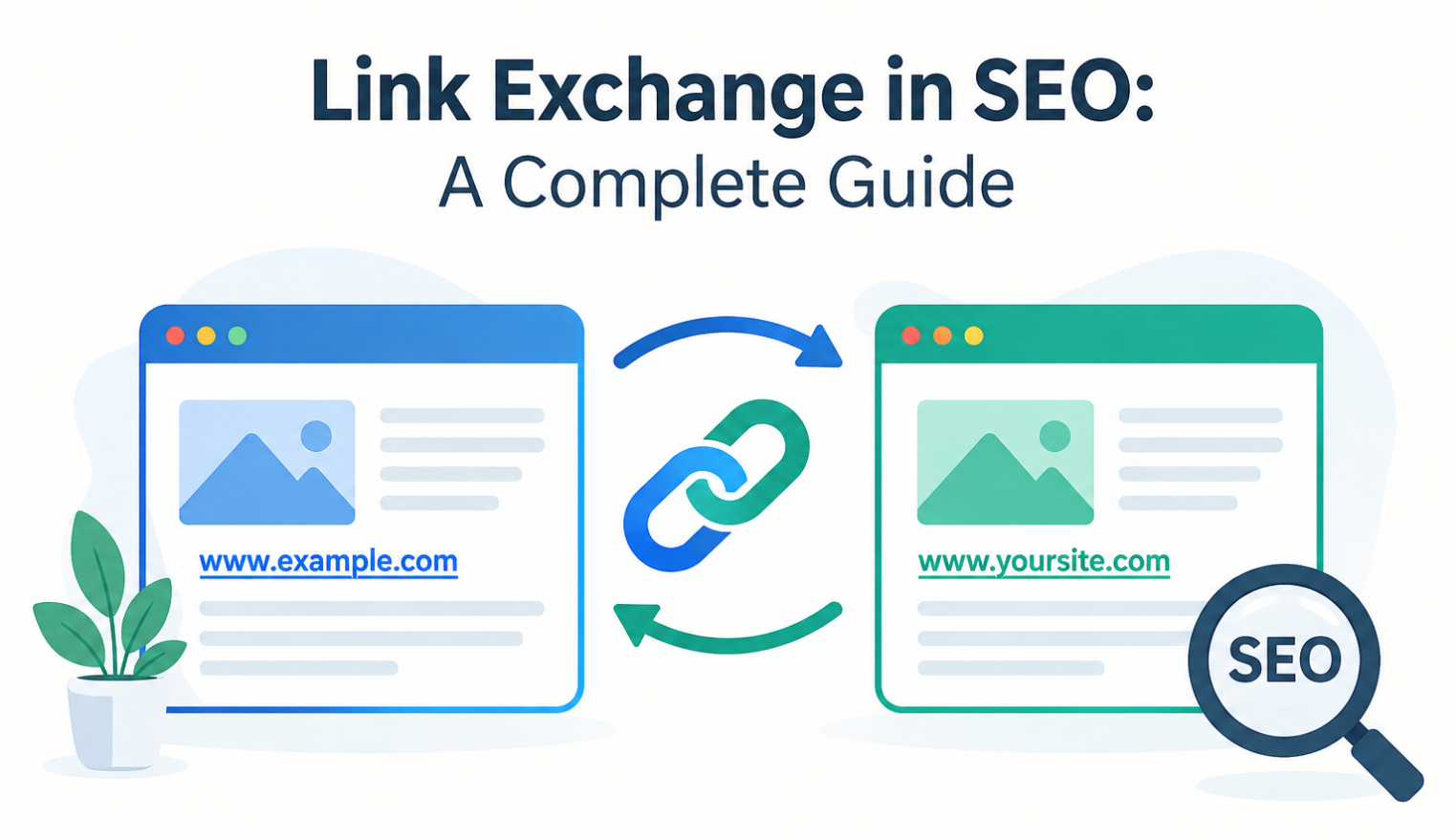
Link exchange in SEO is an arrangement in which two similar and related websites link to each other. For example, Website A links to Website B, and Website B links back to Website A with a common interest. This is also known as reciprocal linking or backlink exchange in web language.
Links for every website remain an important part of how search engines discover and understand websites. However, exchanging links can lead to SEO scams, as it is regarded as manipulating search rankings, which can later create SEO risks. However, if you do the link exchange in a natural way with quality and relevance, they are regarded as more important than simply increasing the number of backlinks.
For all website owners, marketers, bloggers, and SEO professionals, you should better understand how link building and exchanges work and how they can help create a more sustainable backlink strategy.
What is Link Exchange SEO?
A link exchange occurs between two website occurs when two or more websites agree to link to one another.
For example:
Website A → Website B
Website B → Website A
Link exchange SEO is one of the major strategies where website owners mutually agree to link to each other’s websites or post links to improve search engine rankings.
When link exchange is done with high-quality backlinks, both sites will have benefits like increased domain authority, better visibility, and faster indexing by Google. This strategy is also regarded as an SEO best practice for SEO optimization.
Link exchange is often described this way, but as the sections below explain, Google does not treat it as a ranking or indexing shortcut.”
Does Link Exchange Help SEO?
Google’s algorithm values backlinks as a key ranking factor, but it evaluates why a link exists — not just that it exists. A link earned because another site’s editor genuinely found your content useful carries weight. A link created solely through a mutual arrangement to trade placements does not, and at scale, it’s one of the patterns Google’s spam systems are built to detect and discount.
Benefits of Link Exchange in SEO
When a link exchange happens naturally between two genuinely related sites, it can help readers discover relevant resources and give both sites modest referral traffic. But search engines do not reward link exchange as an SEO tactic in itself
Google has stated plainly that reciprocal linking done to manipulate rankings is treated as link spam, not as a ranking benefit. Any site promising “faster indexing” or “higher DA” through link exchange is describing a myth, not a Google-sanctioned mechanism.
How Does Link Exchange Work?
Generally, the Link Exchange in SEO involves the following steps:
- Identifying a relevant website
- Establishing a relationship with the website owner
- Finding useful and relevant content that could be referenced
- Adding the relevant link within appropriate content
- The other website independently linking to useful content in return
The key factor while doing link exchange for SEO is done with the intent and relevance. A genuine editorial relationship is always a different matter from a large-scale scheme designed only to generate backlinks.
Is Link Exchange Good for SEO?
The exchange of links provides value when those links occur between websites that share related subjects.
As an example, two medical organizations are likely to cite the educational materials of each other because the patients and students using the websites gain knowledge from those materials.
But the act of exchanging links in large quantities to change search engine rankings violates official instructions. The spam policies of Google define link spam as any behavior that attempts to control rankings through links.
Experts in search engine optimization are responsible for obtaining links that provide utility and relevance through editorial choices instead of increasing the number of reciprocal backlinks. The Link Exchange in SEO has become one of the most popular among SEO professionals nowadays.
Potential Benefits of Relevant Link Exchanges
Referral Traffic
The presence of a link on a website with similar content is a method to present your data to new viewers and create referral traffic.
Industry Relationships
Collaborating through legitimate methods is how website administrators create connections with companies, publishers, investigators, institutions, and workers in a specific field.
Content Discovery
Links are the tools that allow readers and search crawlers to find helpful pages and digital materials.
Brand Visibility
The act of being cited by relevant websites is what increases the recognition of your agency, trademark,k or journal.
Resource Development
A website is a useful tool within a specific field when other reputable sites cite its investigations, manuals, statistics, cs or primary documents.
Risks of Link Exchange
Not every backlink is beneficial. Participating in link exchanges might be unworthwhile, as it can prove bad for SEO. Some of the risks are
Excessive Reciprocal Linking
This means that building a lot of reciprocal links for the purely expressed purpose of rankings looks like manipulation.
Irrelevant Links
Links between websites that have no relation have a low value for the user and may cause an unnatural backlink profile.
Link Networks
French tends to really focus on participation in networks designed just to game the search ranking within searchengines’s spam policies.
Low-Quality Websites
Links from link farms, websites whose reason for existence is to sell links (as the name suggests), probably give you close to no value and can be harmful for your site.
Excessive Exact-Match Anchor Text
If you use the same keyword-rich anchor text across numerous backlinks, this may create an unnatural linking pattern that eventually leads to spam linking.
Link Exchange vs Natural Link Building
The major difference is why the between link Natural link building and Link Exchange in SEO.
| Factor | Natural Link | Manipulative Link Exchange |
|---|---|---|
| Main purpose | Help users | Influence rankings |
| Relevance | Usually relevant | May be unrelated |
| Editorial value | High | Often limited |
| User benefit | Clear | May be minimal |
| Scale | Naturally acquired | Often systematic |
| SEO risk | Generally lower | Potentially higher |
If You Do Exchange Links, What to Keep in Mind
To ensure Google-friendly link exchanges, follow these best practices:
1. Exchange Links with Relevant Websites
- Only partner with sites in your niche or related industries.
- Avoid spammy or low-quality websites to prevent penalties.
2. Prioritize High-Domain Authority (DA) Sites
- Target sites with DA 20+ for better ranking impact.
- Check metrics using tools like Moz or Ahrefs.
3. Use Natural Anchor Texts
- Avoid over-optimized keywords like “best SEO services.”
- Use branded or natural phrases (e.g., “Visit TopRecents.com”).
4. Balance Follow & No-Follow Links
- A healthy mix of dofollow (passes SEO value) and nofollow (natural link profile).
5. Avoid Excessive Link Exchanges
There’s no safe cadence or quota for reciprocal linking — frequency isn’t what makes a link natural or unnatural; the editorial reason for it is. Google may penalize sites with too many reciprocal links.
6. Monitor Your Backlink Profile
- Use Google Search Console or Ahrefs to track new links.
- Disavow toxic or spammy backlinks.
Should You Buy Links for SEO?
Buying links is a way of manipulating search rankings, so this method for SEO is risky. Google’s spam policies specifically address that buying or selling links is one of the major intentions to manipulate rankings.
If you have a commercial relationship and have to exchange, the websites should follow applicable search-engine guidance regarding link qualification, including when nofollow or sponsored attributes are appropriate.
Final Thoughts
Link exchange in SEO can be good enough only when websites uses the lreference lin natural way between the each other’s useful and relevant resources. However, reciprocal linking for seo should not become a systematic attempt to manipulate search rankings.
A strong SEO strategy for your content should always focus on relevance, user value, editorial quality, and naturally earned backlinks.