
One afternoon in 2021, a Tuesday, comes to mind when I think about how my former company almost lost a multi-million-rupee supply contract. We were adding another production line for heavy-duty industrial surfactants, and our regular chemical procurement cycle was under enormous pressure from the prices.
In the efforts of saving a few percentage points on the margin, the purchase department ignored our carefully checked pipeline and bought a spot-market lot of Diethanolamine from a local distributor of dubious reputation. It had all the necessary paperwork, standard certificates of analysis, and a price that made the accountants smile.
However, problems started with the trial batch.
After four hours of introducing the material into our reactor cores, the formulation showed evidence of producing a very dark, amber discoloration, while the viscosity got totally out of control. Trace excess moisture and unacceptably high levels of triethanolamine impurities, which had not been detected during the initial spot checks, were the main reasons.
We had to stop operations, get rid of thousands of liters of intermediate materials that had been contaminated, and undergo a three-week operation delay, which was brutal while operating under the stress of finding a reliable partner.
In terms of specialized chemical intermediates, it is very dangerous to cut corners on your feedstock supply chain. You are not just purchasing a chemical compound; you are investing in production line stability, plant safety, and maintaining the brand reputation.
For procurement heads and chemical engineers who manage large-scale industrial portfolios, determining the best Diethanolamine (DEA) Suppliers in India is a vital strategic element.
Whether you are operating gas sweetening plants in the energy sector or creating high-performance agrochemicals, this complex market is not just about scanning a basic catalog or finding the lowest price.
Grasping Micro-Market Dynamics: What is Fueling the Surge?
In fact, if one examines the global chemical market at the moment, the demand curve for alkanolamines, and especially for Diethanolamine (CAS 111-42-2), is demonstrating a considerably steep rise.
Market intelligence revealed that the worldwide diethanolamine market is growing at a compound annual growth rate of about 4.8% and is set to exceed a twenty-billion-dollar valuation over the next ten years. What is absolutely fascinating to a chemical supply strategist is that the domestic market, which is exceeding the global averages, is estimated to be around 5.6% for a yearly expansion rate.
And the reason behind it? Well, take a look at the main industrial sectors that are driving our present economic surge.
1. Gas Treatment and Environmental Compliance
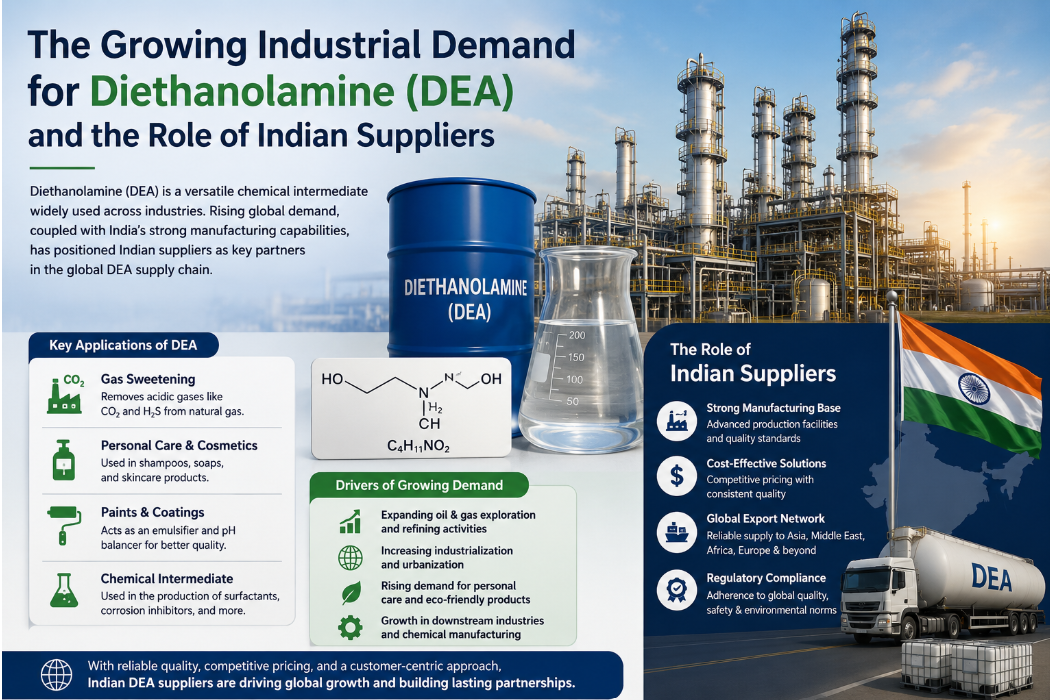
The oil and gas sector, which accounts for almost 29% of the total consumption share of this compound, considers DEA to be the operating agent of gas sweetening plants. It is a chemical absorbent with high efficiency that is utilized for the removal of poisonous hydrogen sulfide and carbon dioxide from sour natural gas streams prior to their being sent through transmission pipelines.
Since there has been a stricter control of industrial emissions in the whole of the subcontinent, refineries are being forced to maintain a constant amine quality, as even a slight change in purity causes foaming in the absorption tower. This, in turn, results in surface amine being carried away and subsequent corrosion, which are the two problems that lead to high costs.
2. The Agrochemical Boom
And the agriculture sector deserves a mention here too. It is the economic mainstay of our country and the sector that is facing the brunt of scaled-up crop chemicals and systemic herbicides production.
DEA is a vital structural intermediate in the manufacture of those weed-control agents and pesticide adjuvants that are used by the chemical formulators most of the time.
Therefore, their stock needs to be stable. During a campaign season of a chemical plant for agriculture, the demand for the product shoots up instantaneously, so they have to rely on partners who can fulfill their requirements without any trouble or discomfort.
3. Personal Care and Surface-Active Agents
Never skip the consumer goods sector. The huge jump in spending on luxuries has led to a simultaneous boom in the personal care and industrial cleaning products markets.
When DEA is combined with fatty acids, it results in the formation of fatty acid amides such as Cocamide DEA, which, among other things, serve as excellent foam stabilizers, emulsifiers, and viscosity enhancers in a wide range of products from industrial floor cleaners to high-end commercial shampoos.
Technical Specifications: Glancing beyond the Generic Datasheet
Once you start thinking about the selection of your Diethanolamine DEA Suppliers India, your technical staff will have to be capable of ignoring the colored brochures handed out for marketing purposes. A typical chemical specification sheet will simply mention that the compound is a colorless, viscous liquid with a scent somewhat reminiscent of ammonia. The standard molecular parameters will be listed. But that is just scratching the surface of the information.
If you want to come up with an appropriate procurement matrix for this substance, you need to evaluate the impurity profile.
- Purity Levels (Assay): When purchasing products from major manufacturers, the expected assay level should be 99% and above. Lower levels indicate that the consumer buys extra precursors and reaction products with reduced catalytic activity upon use.
- Inefficient distillation leads to higher concentrations of MEA and TEA in DEA. They negatively impact the properties of a solution, particularly its pH level, which is critical in many applications, for example, in cosmetics.
Essential Procurement Hint: If your factory is located in areas where it gets pretty cold or comes under heavy winter weather conditions, you must inquire about Low Freezing Grade (LFG) varieties.
Plain DEA freezes at 28 °C, making it impossible to pump as it becomes a crystalline solid. LFG products, carefully mixed with about 10% water, considerably reduce the crystallization point. They are capable of saving enormous amounts of energy, which would have otherwise been wasted on steam tracing of pipes and heating of storage drums.
Managing the Sourcing Jungle: How to Identify the Right Industrial Partner
Strategy talk. How do you really distinguish a world-class manufacturing facility from a second-rate broker who happens to have an elegant website? It is down to checking infrastructure, quality control frameworks, and supply chain security on a long-term basis.
Regulatory Compliance and Safety Audits
The first step is to check the certifications. DEA is a classified hazardous chemical; it causes severe eye damage, is a skin irritant, and there are regulations concerning its handling and disposal. Prioritizing only those Diethanolamine (DEA) Suppliers India that possess robust, fully active REACH registrations, besides ISO 9001:2015 for quality management and ISO 14001 for environmental systems, is a must.
Run away if a supplier refuses to provide their Material Safety Data Sheets (MSDS) or if they are unable to explain their transport emergency cards (TREMCARDS) handling clearly, as it not only increases the liability of your operations but is not worth it.
Infrastructure and Storage Potential
Just imagine – what will happen if shipping lanes are disrupted, or the price of ethylene oxide or ammonia feedstock suddenly soars? A middleman who stores the commodity in a rented, un-blanketed warehouse would be the last person to protect you from these supply chain dislocations. During a physical or virtual audit of their warehouse, remember to ask about these critical specifications:
- Storage in Stainless Steel: DEA stored in carbon steel tanks tends to turn black after prolonged exposure to moisture. Reputable suppliers would use 316 stainless steel or coated tanks for storage.
- Nitrogen Blanketing: Since DEA darkens upon exposure to air, a continuous positive blanket of nitrogen over all storage tanks and filling lines is mandatory.
- Testing Facilities: Does the stockist have a NABL-accredited lab, or do you have to wait three days for a third-party lab to perform gas chromatography tests on a sample sent to them? What you should be looking for are on-the-spot quality control certificates for every DEA batch that leaves their warehouse.
The Logistics Factor: Quick Delivery and Risk Reduction
We are living in an economic era of high volatility, where it is your competitive edge that a quick supply of materials gives you. When things are working well, one tends to overlook the importance of logistics. It is only when the distribution of a critical raw material gets held up at a port or gets stuck at customs that you begin to realize how time is becoming your enemy and eating into your profit margins.
The main reason that you should deepen your relationships with the leading Diethanolamine (DEA) Suppliers India is to make your supply chain robust enough to withstand the risk of international material/pipeline disruptions.
Dependence on only direct import spot contracts totally keeps your manufacturing schedule hostage to ocean freight fluctuation problems, container shortages, and unexpected tariff changes. A local supplier with dedicated storage facilities in major industrial hubs such as Gujarat, Maharashtra, or Chennai can provide bulk deliveries through specialized ISO tank containers or good road tankers within 48 to 72 hours.
Besides, one must check their chosen supplier’s way of handling raw material pricing changes. DEA production cost depends directly on petrochemical feedstock prices and energy costs, among other things.
A capable supplier will never hit you with price hikes without prior notice whenever the market changes; rather, they might offer you structured hedging mechanisms, long-term formula-based pricing agreements, or volume-backed buffer stocks, so that your finance team can forecast the operational costs with a high degree of certainty.
Balancing the Equation: Cost vs. Value in the Indian B2B Chemical Market
I understand like nobody else that optimizing procurement spend is the greatest pressure for the purchasing manager. It will seem as if the quotes to be offered to you will be so low that one cannot resist them. It is an incredibly tempting offer,r and I am not even trying to discourage you. However, in the industrial chemical sector, the price,ce which is significantly below normal price levels, is almost always an indicator of compromised quality or cutting corners somewhere down the line.
When a supplier undercuts the market significantly, the three most likely things they will do are: mixing batches from variable, unverified global origins; skipping rigorous quality verification processes; or using inferior packaging that exposes the chemical to moisture and oxidation.
Given your very loosely connected network of them, you cannot expect quality maintenance from them. The paper savings you generate initially disappear immediately upon the contamination/accredited batch, causing deviation of your reactor kinetics, clogging of your processing lines, or production of a final defective product that your clients reject.
The wise move is to put the highest weighting on the total cost of ownership (TCO). An experienced partner that provides regular, high-purity chemical batches together with complete documentation, punctual delivery, and efficient technical support can save your company millions, not only due to eliminating downtime but also in reduced re-work and improved process efficiency.
Final Thoughts: Securing Your Structural Foundation
Essentially, the resilience of your production facility depends on the weakest link in your raw material supply chain. Diethanolamine may only be a minor component in your entire formulation, but its functional role as an intermediate, neutralizing agent, or gas scrubber makes it absolutely indispensable for your overall operational success.
As you make your chemical procurement plans for the next few quarters, thoroughly examine your supplier base. Don’t merely rely on infrequent dealings with chemical brokers who supply generic products. Identify and establish partnerships with top-tier Diethanolamine (DEA) Suppliers India who not only know the technical aspects of your business but also are very well equipped with state-of-the-art handling infrastructure and can prove their dedication to the long-term security of the supply chain.
During your upcoming vendor review, raise challenges, explore various impurity profiles in detail, evaluate their storage blanketing protocols, and measure their logistical responsiveness through smaller trial runs. By connecting your chemical supply chains with recognized quality standards now, you will be able to operate your downstream industrial processes with clarity and confidence.