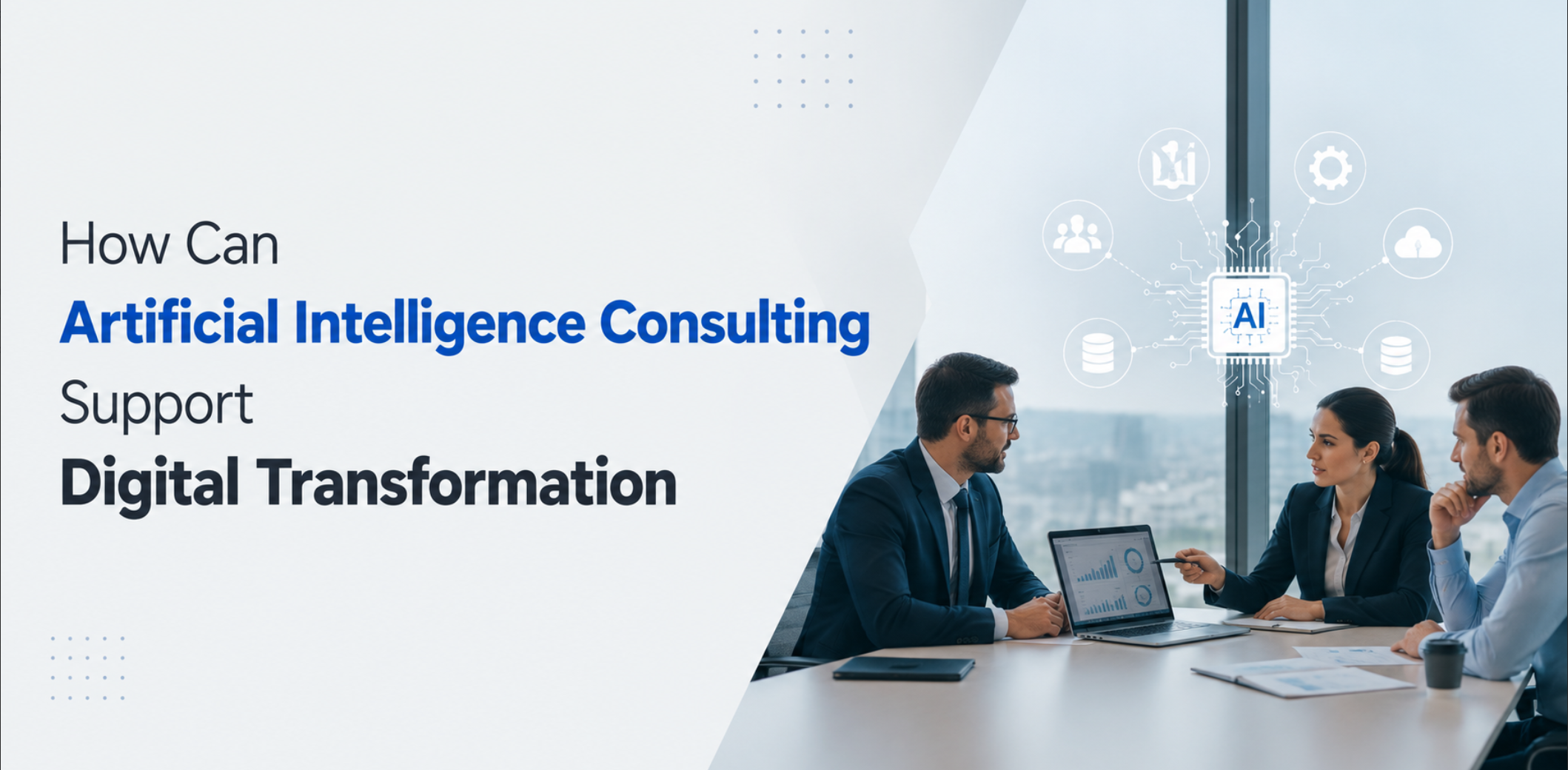
Every board deck now has an AI slide. Fewer boards can explain what happens after the slide gets approved.
- 01. The Transformation Everyone Claims, Few Deliver
- 02. What an AI Consulting Company Is Actually For
- 03. It Separates the Interesting Problem From the Right Problem
- 04. It Owns the Sequencing Decision
- 05. It Builds the Business Case a CFO Will Actually Sign
- 06. AI Governance and Consulting: The Layer Boards Underfund
- 07. Governance Solutions vs. Governance Theater
- 08. The AI Readiness Assessment: Diagnose Before You Spend
- 09. AI Consulting Company vs. AI Development Agency: Different Contracts, Different Risks
- 10. Where This Breaks in Practice
- 11. What Separates Real Consulting From Vendor Theater
- What Are Guest Post Guidelines? A Beginner’s Guide
- Link Exchange in SEO: A Complete Guide to Know

- The Art of the Hook: How to Write Enticing Introductions in Blogging and Essay Writing

- How a Website Audit Helps Improve User Experience and SEO Together
- What SEO Content Tips Top Digital Marketing Firms Always Follow

- How to Rank Your Blog in Google’s Top 10 Search Results

That’s the actual gap in digital transformation right now. Not ambition, execution. Companies aren’t short on AI ideas. They’re short on the strategic scaffolding that turns an idea into a system that survives contact with production data, compliance teams, and quarterly earnings pressure.
This is where artificial intelligence consulting earns its budget line. Not by writing code faster than your engineers. By forcing the sequencing decisions your org chart is too polite to force on its own: who owns the risk, who signs off on the data, and what gets built first.
The Transformation Everyone Claims, Few Deliver
McKinsey’s 2025 AI survey found that 88% of organizations are already using AI somewhere in their business. Barely a third have pushed it past that first use case. That’s not a technology gap. It’s a strategy gap wearing a technology costume.
Deloitte’s 2026 enterprise AI research shows the same split from a different angle. Two out of three companies say AI is boosting productivity somewhere in the business. But only one in five are seeing the revenue growth that three in four of them are still banking on. The gains are real. They’re just not turning into transformation.
The pattern repeats because most organizations skip a step nobody wants to own: deciding, before building anything, which problems actually warrant an AI solution and which don’t.
What an AI Consulting Company Is Actually For
Strip away the marketing language, and a good AI Consulting Company does three things a development team structurally cannot.
It Separates the Interesting Problem From the Right Problem
Engineering teams get excited by what’s technically possible. Consultants are paid to ask whether it’s commercially necessary. Those are different filters, and conflating them is how six-figure pilots die in a drawer.
It Owns the Sequencing Decision
Data architecture before model selection. Governance before deployment. Pilot before scale. This order sounds obvious written down. It’s routinely inverted under deadline pressure, and inversion is expensive to reverse mid-project.
It Builds the Business Case a CFO Will Actually Sign
AI Consulting Services worth paying for producing a document with numbers in it cost to build, cost to run, expected payback window, and the assumptions behind each figure. Not a vision statement. A model your finance team can stress-test.
AI Governance and Consulting: The Layer Boards Underfund
Here’s the uncomfortable one. Deloitte’s latest enterprise data shows only one in five companies has a mature model for governing autonomous AI agents. The rest are scaling authority they can’t fully audit.
AI Governance and Consulting is not about adding a compliance checklist after an AI system has already gone live. AI governance should start when you build the system.
It defines how AI makes decisions and who takes responsibility. It also sets clear steps for handling mistakes or unexpected results.
In practice, AI governance services should answer four basic questions before launch:
- Decision-making: Who decides what the AI can do?
- Human review: When should a person review the AI’s decision?
- Data: Where does the AI data come from?
- Data quality: Who checks the data for errors or bias?
- Accountability: Can you explain an AI decision if someone challenges it?
- Compliance: Who checks if the system follows current regulations?
Miss any of these and you haven’t gained speed. You’ve just taken out a loan against a liability nobody’s priced yet.
Governance Solutions vs. Governance Theater
| Governance Theater | Real AI Governance Solutions |
| A policy PDF nobody references | Rules embedded in the deployment workflow itself |
| Annual review, retroactive | Continuous monitoring, drift flagged in real time |
| Ownership diffused across “the team” | A named accountable owner per AI system |
| Compliance bolted on post-launch | Compliance requirements shape the build from day one |
The left column costs less upfront. The right column is the only one that survives an audit or a regulator’s phone call.
The AI Readiness Assessment: Diagnose Before You Spend
An AI readiness assessment is one of the highest-value engagements companies routinely skip mostly because week one produces nothing you can put in a board deck. That’s actually the point. It’s diagnostic work, not a deliverable for show.
A real AI readiness assessment looks closely at five areas. The goal is to find gaps, not simply mark everything “yes.”
- Data: Can that data support the decisions AI needs to make?
- Infrastructure: Can they support the needed speed and system connections?
- Skills: Can your team manage and fix the AI system Or will you need outside help whenever something breaks?
- Process: Are the workflows AI will affect clearly documented Or does the process depend on one person’s knowledge?
- Governance: Who decides what AI can do? Are human review rules clear before the system goes live?
Data often becomes the biggest problem during AI projects. Informatica’s 2025 CDO survey found data quality as a major blocker. The survey found that 43% of data leaders named it their top blocker. Poor data can stop a well-funded AI project from reaching production.
Gartner’s projection is blunter still: through 2026, organizations will abandon 60 percent of AI initiatives that lack AI-ready data. A readiness assessment is how you find that out for a fraction of the cost of finding it out mid-build.
AI Consulting Company vs. AI Development Agency: Different Contracts, Different Risks
These two get bundled in RFPs constantly. They shouldn’t be, because they carry different failure modes.
| Comparison Criteria | AI Consulting Company | AI Development Agency |
| Primary deliverable | Strategy, readiness, governance framework | Shipped product, integrations, code |
| Engagement question answered | Should we build this, and how? | Can you build this? |
| Failure mode if skipped | A well-built product nobody needed | Strategy that never gets executed |
| Right sequencing | Engaged first | Engaged after scope is validated |
Some firms run both functions credibly under one roof. Most don’t, and hiring a development team to answer a strategy question or vice versa is how projects burn budget solving the wrong layer of the problem.
Where This Breaks in Practice
Three failure patterns show up consistently across organizations at scale, independent of industry:
The pilot that never gets a production budget. It worked in a sandbox with clean, curated data. Nobody validated it against the messier data reality of full production, so it stalls indefinitely in “promising results” limbo.
The governance retrofit. A system ships fast, works well enough to gain internal traction, then triggers a compliance or bias concern. Governance gets built after the fact, under pressure, which is the most expensive way to build it.
The strategy-development mismatch. Leadership hires a development team to “figure out our AI strategy” because it’s faster to greenlight a build than commission a diagnostic. The team builds competently. The business case was never validated.
The vendor lock-in nobody negotiated for. A development partner builds fast using their proprietary tooling or architecture. Twelve months later, the business can’t move the system in-house or switch vendors without a costly rebuild because nobody scoped exit terms into the original engagement.
None of these are technology failures. All four are sequencing failures and sequencing is precisely what consulting engagements are structured to prevent.
What Separates Real Consulting From Vendor Theater
Before signing with any AI development agency or consulting partner, a few questions cut through the pitch deck fast:
- Will they tell you not to build something, if the data says so?
- Does their proposal include a governance framework, or just a delivery timeline?
- Can they show you how they’ve handled a failed data-readiness check, not just a success story?
- Is the business case in their proposal something your CFO could challenge line by line?
If the answer to any of these is a dodge, you’re looking at a development shop wearing a consulting label and that mismatch is exactly the sequencing risk this article opened with.
Digital transformation doesn’t fail because the technology isn’t ready. It fails because the sequencing decisions data, governance, ownership get made informally, under deadline pressure, by whoever’s in the room. Getting artificial intelligence consulting right means making those decisions on purpose, before the build starts, not after the postmortem.

Facebook Discussion