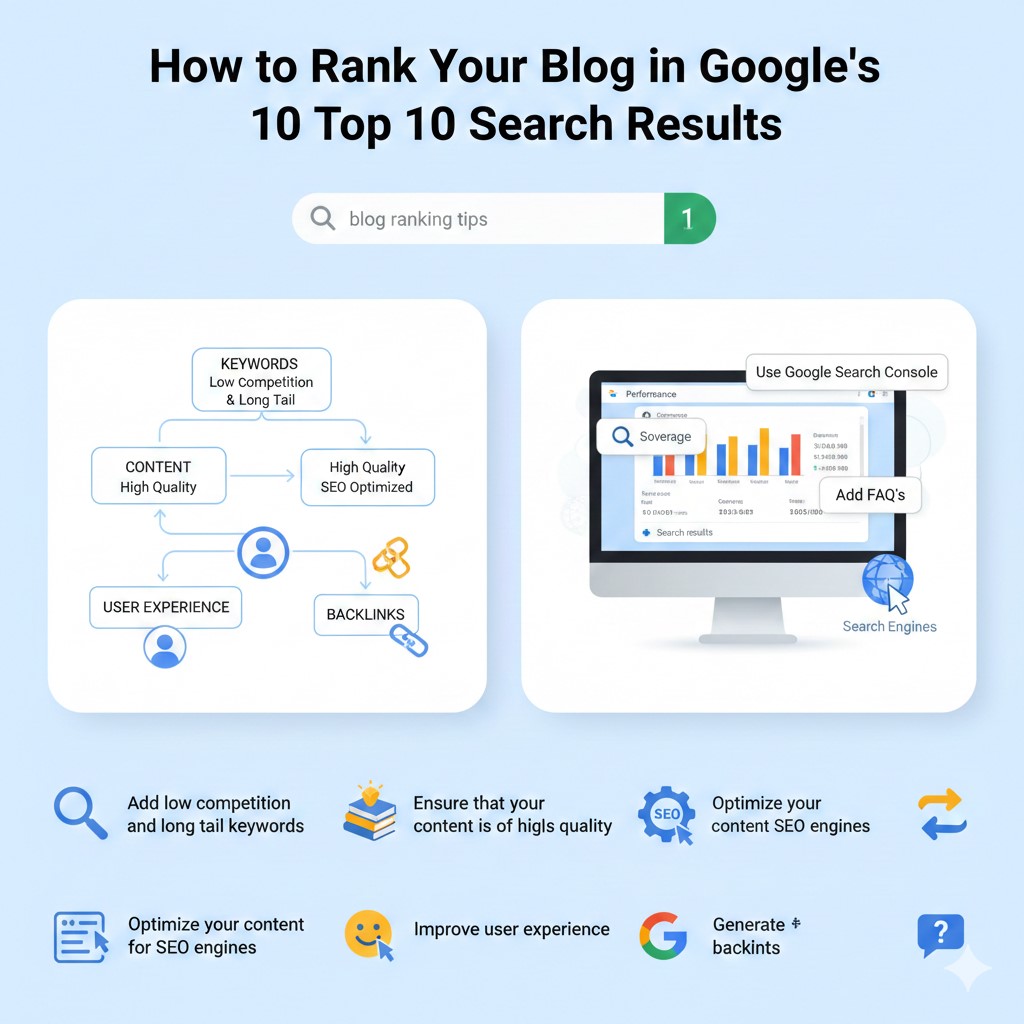
How to Rank Your Blog in Google’s Top Search Results
Do you think that getting in Google’s top 10 search results is luck? Well, it isn’t. Ranking on Google is not luck. It is a strategy instead. Hence, you must also have a clear and effective strategy if you also want your blog to rank higher in Google’s search results.
Are you wondering why ranking high on Google’s search results matters? The answer is that more people will see and click on your blog if it is ranked higher. ‘A large-scale studyof click-through rates found that the top organic result in Google receives about 27.6% ofall clicks on average.’ (source: The SEO Works)
Do you also want to rank your blog in the top 10 search results of Google? I will help you. This blog will guide you with effective strategies to help your blog rank higher in search results. Let us begin!
How to Rank Your Blog Higher on Google?
The following are some strategies that would definitely help your blog rank higher on Google.
1. Target Attainable and Long Tail Keywords:
First of all, you must target keywords that are actually worth your energy and time. You must avoid using keywords that are too competitive. The chances for your blog to rank high can be much lower due to intense competition. In addition, target long tail keywords. They have higher click through rates because these keywords are more specific. And they are more relevant for searchers.
However, you must not stuff keywords into your blog just to rank it higher in the search engine. The following are some of the best SEO keyword research tools:
- Google Keyword Planner
- Google Trends
- AnswerThePublic
- Keyword Tool
- Semrush
- Soovle
2. Create High Quality Content:
You must also ensure that your blog is top-notch. But what does it mean to create high-quality content? It simply means creating content that meets the user’s intent. In simpler words, your content must be helpful and relevant to the user’s search. And it must answer the user’s queries. Besides, your content must also prioritize E-E-A-T. This is one of the most important factors to make our blog higher in Google’s search results. But what does E-E-A-T even mean? It actually stands for:
- Experience
- Expertise
- Authoritativeness
- Trust
This simply means that your content must look like it is written by an expert. You basically have to build trust among your audience with your content. And how can you do that?
- Use actual names in your blog
- Share the story as you have personally experienced it. You must also include personal opinions
- Keep the tone of your content conversational (make it engaging)
- Ensure that every fact and stat in your content is accurate and relevant
This is how you can prioritize E-E-A-T in your content. Now use this checklist to ensure that your content is of high quality:
- Your content answers the user’s questions clearly
- It is grammatically correct and free from plagiarism
- You have used images to showcase your ideas
- Your content is relevant to your target audience
- It provides accurate information with evidence
- Cites reliable sources
- You have used headings, subheadings, and bullets to keep it organized
After this, you will definitely be able to create top quality content.
3. Optimize Your Content for SEO Engines:
Now that you have created a high quality blog, let’s optimize it. But what does optimizing your content mean? It simply means adding your target keyword in the title, meta description, and in the content of your blog. But ensure not to stuff keywords. Balance them instead. For instance, if your keyword is Assignment Help, then the keyword density must be between 0.5% to 1.5%. In simpler terms, you have to use the keyword only 5 to 10 times.
You must also include internal linking and alt text for images. This On-Page SEO is actually quite crucial for your blog’s ranking.
4. Ensure to Improve the User Experience of Your Website:
Now you don’t want your audience to visit your website and leave without getting their answers. Do you? Obviously not. Nobody wants that. But due to bad user experience, searchers may leave your website without getting what they want. This can hurt your blog’s ranking. But what factors can enhance the user experience?
- Fast-loading websites
- Mobile-friendly content
- Secured connections
Ensure these factors to make your website content rank higher in Google’s search results
Generate Backlinks:
You must also generate backlinks in your blog. But what does backlinking even mean? You basically link reputable and high authority websites to your blogs. This helps you ensure that Google knows that your content is highly trustworthy. This will also help you rank your blog in Google’s top 10 search results.
Use Google Search Console:
You can also use Google Search Console to know how your website is performing on search results. But is it free? Yes, it is. You can also submit your sitemap to Google to improve your ranking. You must first verify that you own your website. Then you can use Google Search Console. You can also find out how many people actually visited your website. And also, which keywords they use.
Add FAQ’s:
Besides, you should also add FAQ’s in your content. This will help you get featured snippets. But what actually is a featured snippet? It is basically a summary of your answer that appears at the top of Google’s search results. But the answer must be accurate and relevant to the user’s question. You must include questions that your target audience is most likely to search for. And give a clear and concise answer to it.
In a Nutshell!
All in all, ranking your blog in Google’s top 10 search results is not difficult. All you need is just a right plan and an effective strategy. Use these strategies to rank your blog higher in Google’s search results:
- Add low competition and long tail keywords
- Ensure that your content is of high quality
- Optimize your content for SEO engines
- Improve user experience
- Generate backlinks
- Use Google Search Console
- Add FAQ’s
About The Author